
Quick Summary
- Most potty training problems are management problems, not training problems.
- Prevention is far more effective than correction — every indoor accident reinforces the wrong habit.
- Crate training is one of the most effective tools available, not punishment.
- A consistent schedule is the single biggest predictor of success.
- Most puppies become reliable between 4 and 6 months with consistent structure.
Bringing home a new puppy is one of the best things in the world. It’s also, for many owners, the beginning of a frustrating stretch of accidents, ruined rugs, and wondering whether your puppy will ever figure out where they’re supposed to go.
The good news is that most puppies can be successfully housebroken. After training thousands of dogs over the last two decades, I’ve found that most potty training problems aren’t really training problems at all. They’re management problems.
Your puppy isn’t being stubborn. They aren’t trying to upset you. They simply don’t yet understand the rules — and they haven’t had enough opportunities to build the right habits.
In this guide, I’ll walk you through the same schedule-based system we use with puppies here at The Dog Training Institute. It’s straightforward, it works, and it takes a lot of the frustration out of the process.
Why Most Potty Training Fails
The most common mistake owners make is expecting too much too soon. A young puppy has limited bladder control and no real understanding of where they’re supposed to go. When they have an accident inside, it’s almost always because they were given an opportunity to have one.
According to the American Kennel Club’s Chief Veterinarian, Dr. Jerry Klein, the timeline for potty training depends largely on the schedule you keep — not the breed, not the intelligence of the dog, and not any special technique. Most puppies take 4 to 6 months to become reliably house trained, though individual timelines vary.
The patterns that slow things down almost always look the same:
- Giving too much freedom too early
- Not supervising closely enough
- Waiting too long between potty breaks
- Inconsistency with schedules
- Allowing accidents to go unaddressed and become habits
Every accident your puppy has inside reinforces the idea that going indoors is acceptable. The more a behavior is practiced, the stronger it becomes. That’s why prevention is far more powerful than correction. The goal isn’t to catch your puppy making mistakes. The goal is to stop mistakes from happening in the first place.
How Puppies Actually Learn House Training
Dogs learn through repetition and consistency. Every time your puppy successfully goes outside, they strengthen the habit you want. Every time they have an accident inside, they strengthen one you don’t.
Think of potty training as building a routine that eventually becomes automatic. Your puppy learns where to go, when to go, and what happens afterward. Over time, going outside becomes their default — not something they have to think about.
The challenge is stacking up enough successful outdoor repetitions before indoor accidents have a chance to become their default instead. This is why consistent training — routine and frequent outdoor trips, especially after waking, eating, or playing — is considered essential for success.
The Biggest Mistake: Too Much Freedom Too Soon
Many owners bring home an 8-week-old puppy and let them roam the house. The puppy disappears around a corner for thirty seconds. Everything seems fine. Then you find a puddle behind the couch.
Young puppies should not have unrestricted access to your home. Freedom is something that gets earned over time as reliability improves. The more freedom your puppy has, the harder it becomes to supervise them and prevent accidents. Think of it the same way you’d think about handing a new driver the keys to a race car — the privileges come after the track record is established.
Why Crate Training Is So Effective
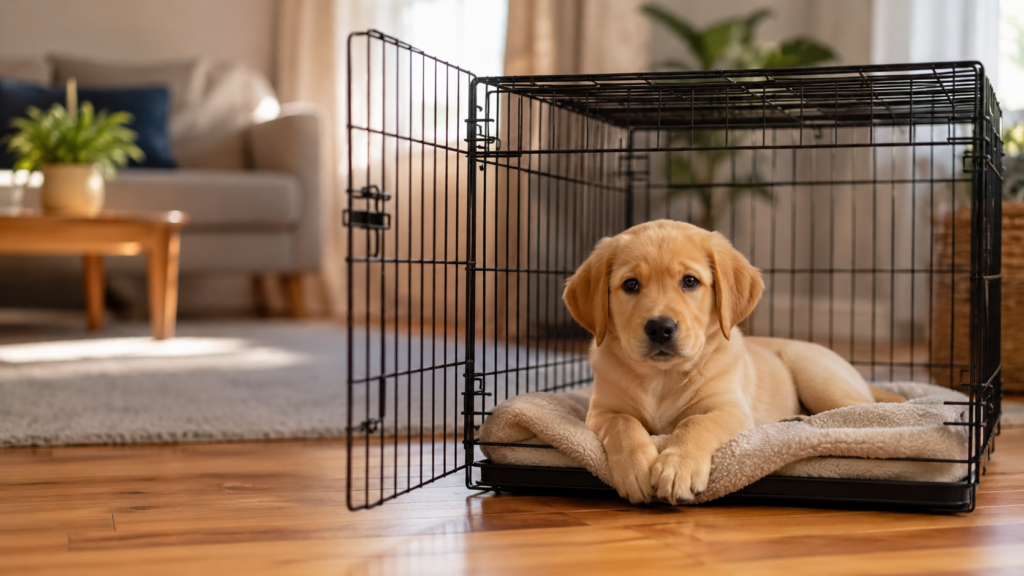
Some owners feel guilty about using a crate. When used correctly, it is one of the most valuable tools you have — and most veterinarians, trainers, and breeders recommend it for exactly that reason.
Dogs instinctively try to keep their sleeping areas clean. The crate takes advantage of this instinct, helping puppies learn to hold and strengthen their bladder and bowel muscles, making housebreaking significantly easier. As PetMD notes, dogs don’t like to soil the area they sleep in, so a crate helps puppies learn to hold their bladder for longer periods of time.
The crate also provides structure, prevents destructive behavior, builds independence, and gives your puppy a calm place to decompress. Veterinary behavior experts note that scheduled rest periods in a crate reduce overstimulation and provide predictable downtime, which is particularly important for young puppies and high-energy dogs.
One important note: the crate must be properly sized. A crate that is too large may be seen by your puppy as an invitation to eliminate in one corner and sleep in another, which defeats the purpose entirely. The crate should be just large enough for your puppy to stand up, turn around, and lie down comfortably.
The crate is not punishment. It is a management tool that helps your puppy succeed while good habits are being built.
The Schedule-Based Potty Training Method
The foundation of successful potty training is a consistent daily schedule. Your puppy should know when they are sleeping, playing, eating, and going outside. The more predictable the routine becomes, the faster your puppy learns.
Morning: The Most Important Potty Trip of the Day
The moment you wake up, your puppy goes outside. Not after coffee. Not after checking your phone. Directly outside. This first trip of the morning is one of the most important of the day.
After they’ve gone potty, take them for a short walk. A simple guideline is one minute of walking per week of age:
- 8-week-old puppy — 8-minute walk
- 10-week-old puppy — 10-minute walk
- 12-week-old puppy — 12-minute walk
Pay attention to your puppy. If they sit down or seem tired, don’t push them to continue. The goal is exercise and exposure, not exhaustion.
Morning Feeding
After the walk, it’s time for breakfast. Allow access to food for about 5 to 10 minutes. If they don’t eat, remove the food and wait until the next scheduled feeding. This builds predictable eating habits — and predictable eating habits lead to predictable elimination habits.
Offer water when your puppy goes outside rather than leaving it continuously in the crate. This lets you monitor intake and reduces unnecessary accidents.
Immediately after eating, take your puppy back outside. Many puppies need to eliminate shortly after meals.
The Core Daily Cycle
The rest of the day follows a simple, repeating pattern:
- Potty break outside
- 10 minutes of play and interaction
- Back to the crate for 1.5 hours
- Repeat
This structure dramatically limits the opportunities for indoor accidents. Most of the time your puppy isn’t actively supervised, they’re in their crate — which means they’re either resting or actively working to hold it until they go outside.
How Often Should Puppies Go Outside?
This is one of the most common questions we hear from new puppy owners. The answer depends on age, size, and individual development. Here are general guidelines:
| Age | Frequency During Active Play | Notes |
|---|---|---|
| 8–10 weeks | Every 10–15 minutes when awake | Bladder is tiny; err heavily on the side of more frequent trips |
| 3–4 months | Every 15–20 minutes during supervised play | Starting to develop more control; watch for early warning signals |
| 4–6 months | Every 20–30 minutes during active periods | Reliability building; crate intervals can gradually extend |
| 6+ months | Gradually extend as reliability improves | Most puppies become highly reliable in this window with consistent training |
These are guidelines, not rules. Pay attention to what your puppy is telling you. If they consistently have accidents before the scheduled potty break, shorten the interval. Success leaves clues.
Indoor Play and Supervision
Puppies need play and interaction — but indoor freedom should always be carefully managed. When your puppy is not in their crate, they should either be actively supervised, in a contained area, or tethered close to you.
Tethering is one of the most underused tools in potty training. Simply attach your puppy’s leash to your belt while you move around the house. Now they can’t disappear behind furniture or sneak off into another room — and you immediately notice any early signs that they need to go outside.
Warning Signs Your Puppy Needs to Go
Many owners miss the early signals. Learning to read them is one of the fastest ways to reduce accidents. Watch for sniffing intensely, circling, suddenly wandering away, squatting, restlessness, pacing, or stopping play abruptly.
When in doubt, take them outside. It’s always better to make an unnecessary trip outdoors than clean up another accident inside.
When Is Puppy Biting Actually a Problem?
Most puppy biting is normal. But there are situations where professional input is worth seeking sooner rather than later. Consider reaching out if your puppy shows aggression around food or toys, bites with unusual intensity that seems beyond normal play, displays fear-based behavior alongside the biting, causes repeated injuries, or becomes increasingly reactive over time rather than improving.
True aggression in young puppies is relatively rare — it’s usually accompanied by stiff body language, resource guarding, or snarling that looks distinctly different from playful mouthing. Most of what owners describe as “aggressive biting” is either normal play drive or an overtired, overstimulated puppy who needs a nap. But when in doubt, having a professional assess what you’re seeing is always the right call.
How Long Does Puppy Biting Last?
The most intense biting phase typically peaks between 8 and 20 weeks, then begins to decrease significantly around 6 to 9 months as adult teeth finish coming in and emotional regulation improves. Most puppies show meaningful improvement by 6 months with consistent training and management.
That said, age alone doesn’t solve the problem. The puppies that improve fastest are the ones whose owners provide structure, enforce routines, use the crate appropriately, redirect consistently, and focus on impulse control from the beginning. Puppies who are left to figure it out on their own — with lots of freedom and inconsistent responses — often continue biting well past the teething phase because the habit has been reinforced.
Frequently Asked Questions
Why does my puppy bite me but not my spouse?
Puppies tend to bite most the people who interact with them most, or who produce the most exciting reactions. If you yelp, laugh, or engage actively when bitten, that response can reinforce the behavior. Consistency matters — everyone in the household should respond the same way.
Should I let my puppy chew on my hands?
No. Consistency is everything here. If hands are sometimes toys and sometimes not, your puppy receives mixed messages that slow the learning process considerably. Hands should never be appropriate chew objects — redirect to a toy every single time without exception.
Will my puppy outgrow biting on their own?
Many puppies do improve with age and teething completion, but training and management still matter. Puppies that are allowed to rehearse biting without consistent redirection often carry the habit past the teething phase because it has been reinforced so many times. Age helps, but it doesn’t do the work for you.
Is my puppy being aggressive?
In most cases, no. Normal puppy mouthing and play biting are very different from true aggression. True aggression typically involves stiff body posture, snarling, growling over resources, or biting that seems targeted and fearful rather than playful and aroused. If you’re unsure, a professional assessment is worthwhile — but most puppy biting falls firmly in the “normal development” category.
Does crate training really help with biting?
Significantly, yes. Many biting problems are rooted in overstimulation and sleep deprivation rather than a training deficit. The crate provides enforced rest during those windows, which is often the single fastest fix for a puppy that seems out of control. An overtired puppy that won’t listen to anything you say will often wake up from a crate nap as a completely different dog.
How much exercise does my puppy actually need?
Less than most owners think. A simple guideline is about one minute of leash walking per week of age — so an 8-week-old puppy needs roughly an 8-minute walk. More is not always better and can contribute to the overstimulation cycle. Short, structured play sessions combined with training and adequate rest tend to produce far better behavior than long, exhausting exercise sessions.
My puppy bites hardest in the evening. Why?
This is extremely common and has a name among trainers: the “witching hour.” It almost always comes down to accumulated fatigue and overstimulation throughout the day. By evening, the puppy has hit their limit, cortisol is elevated, and self-control goes out the window. The fix is usually more structured rest throughout the day — not more exercise or stimulation in the evening. A consistent bedtime routine that includes a crate nap earlier in the day often eliminates the witching hour almost entirely.
Should I yelp to stop my puppy from biting?
This is often recommended, but in our experience it produces mixed results. Some puppies do respond by backing off. Others become more excited by the noise and bite harder. If the yelp method isn’t working for your puppy after consistent attempts, stop using it and switch to the “become boring and redirect” approach instead. What matters is consistency, not which specific technique you use.
Want a Puppy That’s a Joy to Live With?
Biting, jumping, and poor impulse control are some of the most common things we address in our puppy training program. We work in a real home environment — not a large kennel facility — with only 2 dogs per trainer at a time, so every puppy gets the focused attention and structure they need to build lasting habits. Schedule a free consultation and let’s talk about what your puppy needs.
Free Consultation