
Quick Summary
- Being a great pet and being a great service dog candidate are not the same thing — service work requires far more than basic obedience.
- Washout rates for service dog candidates range from 30% to 50% or higher even at professional programs with selective breeding — temperament is the most common reason dogs don’t make it.
- Under the ADA, there is no required certification for service dogs — what matters is task training and appropriate public behavior.
- A service dog that isn’t ready can cause real harm: to the handler, to the public, and to the broader legitimacy of working service dog teams.
- Neutrality — not friendliness — is often the most important social trait in a service dog candidate.
For many people, a service dog can be genuinely life-changing. Whether it’s helping with mobility, mitigating the effects of PTSD, interrupting panic attacks, providing medical alerts, or performing other trained tasks, a well-trained service dog can provide an extraordinary level of independence and support.
One of the most common questions we receive is: “Can my dog become a service dog?”
It’s a great question, and the answer is more nuanced than most people expect. While almost any dog can be a wonderful companion, not every dog is a strong candidate for service work. Service dogs are asked to perform demanding jobs in challenging environments — and the bar is genuinely high.
The good news is that many dogs can succeed with the right temperament, training, and guidance. The important thing is going into the process with clear eyes about what it actually requires.
What Is a Service Dog Under the Law?
Under the Americans with Disabilities Act (ADA), a service dog is a dog that has been individually trained to perform specific tasks that directly mitigate a person’s disability. The key word is tasks — the dog must be trained to do something specific that helps with the disability, not simply provide comfort through presence.
Service dogs have broad public access rights, accompanying their handlers into restaurants, stores, hospitals, schools, transportation, and most other public spaces where pets are typically not allowed. Under the ADA, public accommodations that deny access to service dogs without justification can face civil and criminal liability.
There is currently an estimated 500,000 service dogs working in the United States, supporting the 27% of American adults who live with some form of disability. Despite that number, demand far exceeds supply — Assistance Dogs International reported a wait list of over 7,600 potential clients as of the end of 2024, even with 12,450 dogs currently in training through accredited organizations.
Service Dogs vs. Emotional Support Animals: An Important Distinction
This is one of the most commonly misunderstood areas in service dog law, and it matters for training decisions.
An emotional support animal provides comfort through its presence. A service dog is trained to perform specific tasks that help mitigate a disability. These are legally and practically different. Emotional support animals do not have the same public access rights as service dogs under the ADA, and they are not held to the same behavioral standards.
Because service dogs accompany their handlers into virtually any public environment, the demands on their behavior are significantly higher. A dog that is well-suited to be a comforting presence at home may not be remotely ready for service work.
The Honest Truth About Washout Rates
Before evaluating your individual dog, it helps to understand the broader picture. Washout rates for service dog candidates are high — even at the best programs in the country.
According to Canine Companions for Independence, even with their own selective breeding program using Labrador and Golden Retrievers specifically selected for service work, only 35 to 40 percent of their dogs graduate to become full-fledged service dogs. Estimates across the broader industry range from 50 to 70 percent of candidates not completing training — most often due to temperament, reactivity, or difficulty with public access environments.
This isn’t a reason to be discouraged. It’s a reason to evaluate honestly. A dog that washes out of service work can still be a wonderful family companion. But going in with clear expectations protects both you and your dog from a process that isn’t the right fit.
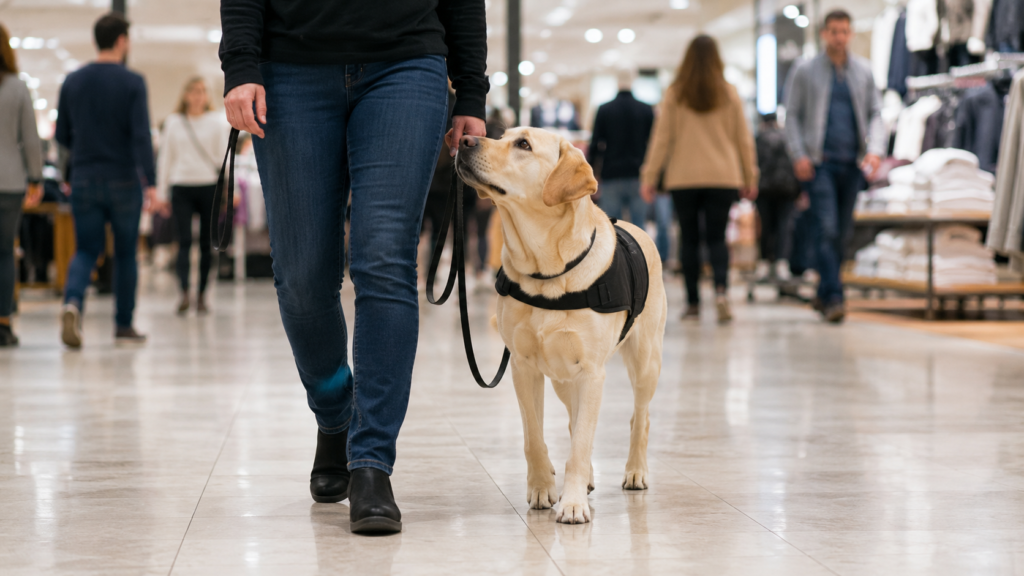
The 7 Things to Consider Before Starting Service Dog Training
1. Temperament — The Most Important Factor
If I could choose only one trait when evaluating a service dog prospect, it would be temperament. A service dog needs to be emotionally stable — recovering quickly from surprises, adapting well to new environments, and remaining composed in situations that would cause many dogs to become anxious or reactive.
Consider what a service dog may encounter in a single week: shopping centers, restaurants, airports, medical facilities, crowded sidewalks, sporting events, school campuses. The dog doesn’t have to love every situation. But they do need to handle those situations calmly and appropriately, every time. Research published in a Washington Post investigation into service dog selection science found that washout dogs showed higher brain activity in areas associated with excitability — suggesting that temperamental stability isn’t just a training outcome, it has a neurological basis that trainers can evaluate early.
A dog that is fearful, highly reactive, or easily overwhelmed is unlikely to succeed at the demands of public access service work, regardless of how much training is invested.
2. Confidence Around People — Neutrality, Not Friendliness
One of the biggest misconceptions about service dogs is that they need to be social butterflies. Friendliness is often less important than neutrality.
A service dog should be comfortable around people without feeling compelled to interact with everyone they encounter. Excessive excitement around strangers can be just as problematic as fear — a dog that is constantly pulling toward people, seeking attention, or getting overstimulated in crowds is not focused on its handler. A service dog’s job is to assist the person they’re partnered with, not to greet everyone in the building.
3. Comfort Around Other Dogs
Just as service dogs must remain calm around people, they must remain neutral around other dogs. This doesn’t mean friendliness or play drive — it means the ability to walk past other dogs, ignore barking, and stay focused on the handler despite canine distractions. Reactivity toward other dogs is one of the most common reasons candidates fail public access standards, and it is one of the harder issues to train around once it exists.
4. Trainability and Motivation
Some dogs simply enjoy learning. They engage with problems, enjoy working with their handler, and respond readily to rewards. Those traits make the advanced skill development that service work requires significantly more achievable.
When evaluating a candidate, we look for food motivation, genuine engagement, the ability to focus, problem-solving willingness, and enthusiasm for working. The more naturally motivated the dog is, the easier it becomes to teach the specific tasks and the layered obedience that public access work demands.
5. The Ability to Relax and Do Nothing
This is one of the most overlooked qualities in service dog selection. Many owners focus entirely on obedience and task performance. Few consider how the dog handles stretches of inactivity.
Yet some of the most critical service dog skills involve remaining calm and settled for extended periods — lying quietly under a restaurant table for two hours, settling during a long doctor’s appointment, resting calmly at work while the handler attends meetings, staying composed on a flight. A dog that constantly needs stimulation or struggles to settle independently can find service work genuinely stressful. The ability to relax is every bit as important as the ability to perform.
6. Physical Health
Service dogs often have long working careers and spend significant time on their feet in public environments. Physical health matters in ways that aren’t always obvious at first. Joint health, overall fitness, chronic medical conditions, and breed-specific health concerns can all affect a dog’s ability to comfortably maintain the demands of service work over time.
This is one reason health screenings are standard practice at professional service dog organizations before dogs advance into more intensive training phases. A dog with significant health limitations may not be able to perform the physical aspects of their role reliably throughout a full working career.
7. The Right Tasks for the Right Dog
Not every service dog performs the same tasks, and the tasks required should match both the handler’s needs and the dog’s natural abilities. Different disabilities require meaningfully different skill sets:
| Service Dog Type | Example Tasks | Key Traits Needed |
|---|---|---|
| Psychiatric Service Dog | Interrupting panic attacks, deep pressure therapy, creating space in crowds, waking from nightmares, redirecting repetitive behaviors | Handler attunement, body awareness, calm under stress, strong handler bond |
| Mobility Assistance Dog | Retrieving items, opening doors, balance assistance, carrying objects | Physical size and strength appropriate to handler, high retrieve drive, steady temperament |
| Medical Alert Dog | Alerting to blood sugar changes, seizure prediction, cardiac events | Exceptional scent ability, very high handler focus, reliable alert behavior under distraction |
| Hearing Alert Dog | Alerting to sounds (doorbell, smoke alarm, name being called) | High environmental awareness, alert nature, reliable touch-based alert behavior |
The task type also affects which breeds tend to succeed. A dog with strong scent drive may excel at medical alert work. A dog with high physical drive and retrieve motivation may be better suited to mobility assistance. Matching the dog’s natural strengths to the required tasks is part of what makes a service dog truly effective.
Does Breed Matter?
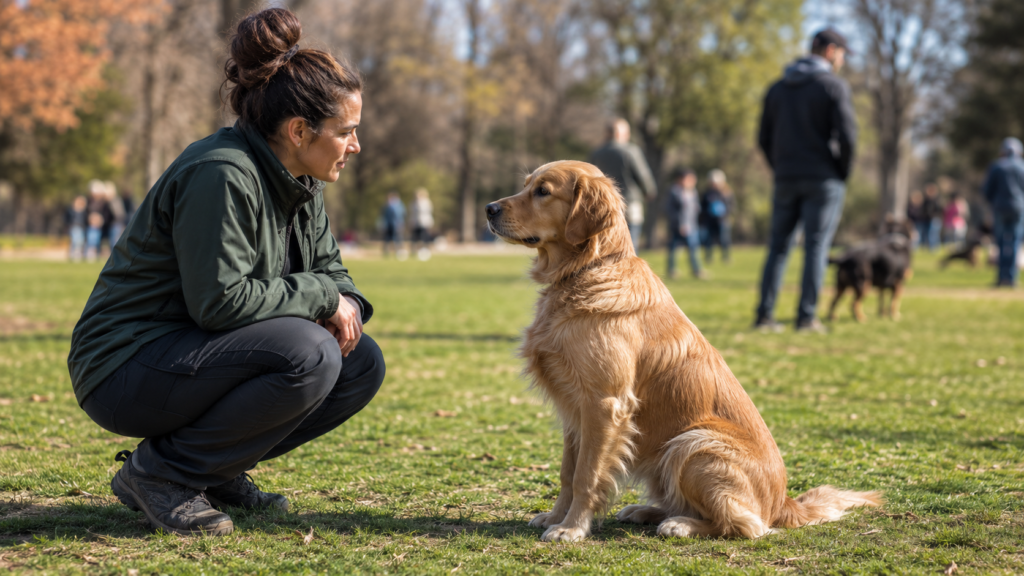
Technically, many breeds can become service dogs — and under the ADA, no specific breed is required or excluded. That said, breed tendencies matter in practical terms.
Some breeds were developed specifically to work closely with humans — Labrador Retrievers, Golden Retrievers, and Standard Poodles are the most commonly placed service dogs precisely because they often combine strong trainability, stable temperaments, social confidence, high food motivation, and a genuine desire to work with people. These traits don’t guarantee success, but they load the odds in a favorable direction.
Breeds developed for greater independence — hounds, terriers, many guardian breeds — can succeed in service work, but they often require more experience to train and may have narrower windows of tasks where they naturally excel. The individual dog ultimately matters more than the breed alone, but understanding your dog’s genetic tendencies helps set realistic expectations from the start.
When Should Service Dog Training Start?
Earlier is almost always better. The socialization window in young puppies — roughly 3 to 14 weeks — is one of the most critical periods for building the kind of neutral confidence that service work requires. Puppies that receive broad, positive exposure to environments, sounds, surfaces, people, and situations during this window build a foundation that’s genuinely harder to create later.
That said, adult dogs can and do become successful service dogs. Age alone is not disqualifying. Temperament, health, trainability, and the specific tasks required matter far more than whether the dog is 8 weeks or 3 years old at the start of training.
How Long Does Service Dog Training Take?
Service dog training is a process, not an event. On average, it takes one to two years to fully train a service dog — and that’s with experienced professional guidance. The process typically includes foundation obedience, public access skills, environmental exposure across many real-world settings, task-specific training, and extensive proofing to ensure reliability under the conditions the dog will actually encounter.
The goal isn’t simply teaching commands. It’s creating reliability under real-world conditions — which requires time, repetition, and a systematic approach to gradually increasing difficulty.
Frequently Asked Questions
Does my service dog need to be certified?
No. Under the ADA, there is no federally required certification for service dogs. What matters is that the dog is trained to perform specific tasks related to a disability and behaves appropriately in public settings. Businesses may only ask two questions: whether the dog is a service animal required because of a disability, and what work or task the dog has been trained to perform. They cannot require documentation, certification, or identification.
Can I train my own service dog?
Yes. The ADA explicitly allows owner-training. However, professional guidance is strongly recommended, particularly for the public access component and task training. Owner-trainers who work with experienced professionals see success rates of around 75% — meaningfully higher than program-only approaches, largely because owner-trainers can invest individualized time and adapt training to their specific dog. That said, the commitment required is substantial.
My dog is well-behaved at home. Does that mean they’re a good service dog candidate?
Not necessarily. Home behavior and public access behavior are very different. A dog that is calm and obedient in familiar environments may become anxious, reactive, or overwhelmed in new places, around strangers, or amid the unpredictability of public settings. Evaluating a dog’s temperament specifically in novel environments is an important part of any honest service dog assessment.
Can an older dog with some reactivity become a service dog?
It depends on the severity and the specific triggers. Mild reactivity that responds well to training is different from significant reactivity that has been reinforced over years. Reactivity toward other dogs or strangers is one of the most common reasons service dog candidates don’t make it through public access training. A professional evaluation can give you a realistic picture of what’s workable and what isn’t for your specific dog.
What happens if my dog washes out of service training?
They continue to be your dog — that’s what happens. A dog that isn’t suited for service work is not a failed dog. They simply have a different calling. Many wash-out dogs make exceptional family pets, therapy dogs, or sport dogs. The traits that make service work difficult — high energy, strong environmental interest, social enthusiasm — are often the same traits that make dogs wonderful companions in other contexts.
How much does service dog training cost?
Professional service dog training from an accredited organization typically costs between $15,000 and $30,000, reflecting the time and expertise involved. Owner-training with professional support is less expensive but still requires significant investment in training time, equipment, and guidance. Some nonprofit organizations provide trained service dogs at reduced or no cost to qualified applicants, though wait times can be substantial.
Can any breed become a psychiatric service dog?
Legally, yes — the ADA does not restrict by breed. Practically, the same temperament criteria apply regardless of the task type: emotional stability, neutral confidence around people and other dogs, ability to relax in public settings, and strong handler focus. A study on psychiatric service dogs for veterans with PTSD found that positive reinforcement and bond-based training methods were consistently associated with better outcomes — underscoring that the training relationship matters as much as the dog’s individual traits.
We train service dogs — what does your program involve?
Our service dog training program is led by Sean Knudsen, who has trained service dogs for over two decades alongside sport dogs, working dogs, and family pets. We work with only a small number of dogs at a time in a real home environment — not a large kennel facility — which allows for the focused, individualized training that service work requires. If you’re wondering whether your dog is a strong candidate, a free consultation is the right first step.
Wondering If Your Dog Has What It Takes?
Sean Knudsen has trained service dogs for over two decades, including dogs placed with veterans, individuals with mobility challenges, and handlers with psychiatric disabilities. If you’re considering service dog training and want an honest, experienced assessment of your dog’s potential, schedule a free consultation and let’s talk through what you’re working with.
Free Consultation