
Quick Summary
- Dog parks are one of the least controlled environments you can intentionally place your dog in — and lack of control is the core problem.
- A national survey found that 15% of dog owners reported their dog being attacked at a public dog park — roughly 1 in 7.
- Frequent dog park visits can actually create reactivity by teaching dogs that every other dog is an opportunity to play.
- The goal of socialization is neutrality — a dog that can calmly walk past other dogs — not a dog that needs to interact with every one it sees.
- Better alternatives exist: structured walks, carefully chosen playmates, training classes, and public outings all build confidence without the risks.
For many dog owners, the dog park feels like the obvious answer. A large fenced area, room to run, plenty of other dogs — on the surface it sounds ideal.
We rarely recommend dog parks. And it’s probably not for the reason you expect.
It’s not that we don’t trust your dog. It’s that you can’t know enough about everyone else’s.
At The Dog Training Institute, one of our guiding principles is simple: whenever possible, control the environment you’re asking your dog to learn in. A public dog park is one of the least controlled environments you can intentionally place your dog in. That alone gives us pause — but the risks go considerably further than just unpredictability.
The Real Risk at Dog Parks
Most owners decide whether to visit a dog park by evaluating only their own dog. “My dog has great recall. My dog loves everyone. My dog has never been in a fight.” Those are all genuinely positive qualities. Unfortunately, they don’t protect your dog from another dog that lacks those same qualities.
A national survey of over 1,000 dog owners in the United States found that 15% reported their dog having been attacked at a public dog park — roughly one in seven dog owners who experienced a dog-on-dog attack at the park. That’s not a fringe outcome. It’s a common one. And the consequences of a single serious altercation can extend well beyond the physical injuries.
Before walking through the gate of any dog park, the honest questions aren’t about your dog. They’re about every other dog present:
- Has every dog there been properly socialized?
- Are they healthy and vaccinated?
- Do they respect other dogs’ body language and boundaries?
- Have they ever bitten another dog?
- Can their owners reliably call them away?
- Are those owners actually paying attention?
The honest answer to all of those is: you don’t know. And that uncertainty is the problem.
You Don’t Need an Aggressive Dog for Things to Go Wrong
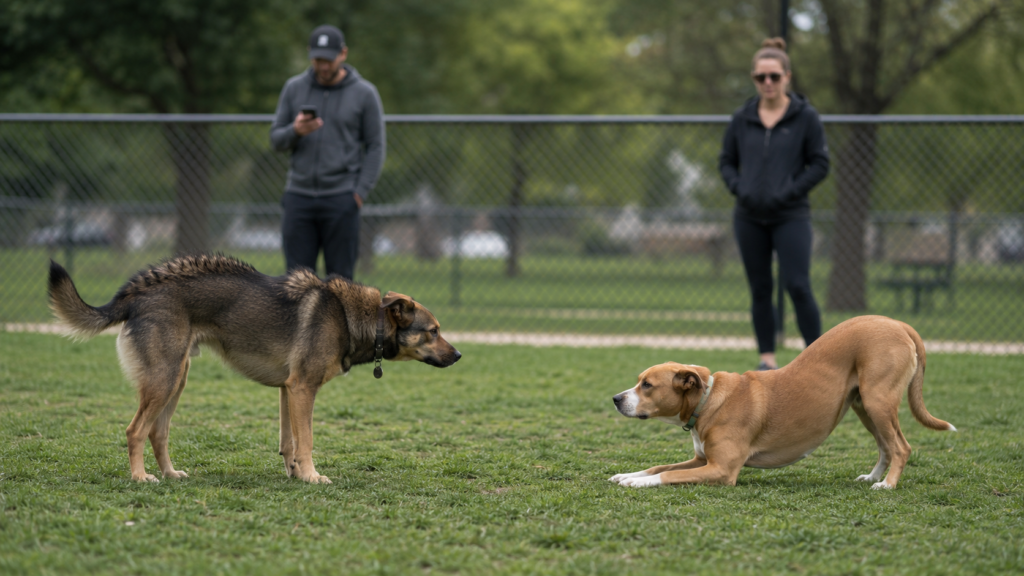
Aggression isn’t the only concern at dog parks — and this surprises many owners. A perfectly friendly dog can be genuinely harmed in ways that have nothing to do with aggression.
A large adolescent dog may body-slam a smaller or younger dog without any aggressive intent. Several excited dogs may begin chasing one nervous dog in a way that quickly becomes overwhelming. A shy dog may be relentlessly pestered by dogs that simply won’t read their signals to back off. None of these scenarios require an “aggressive” dog. They just require dogs with different personalities, different play styles, and owners who may not recognize when the dynamic has shifted from play to stress.
When multiple unfamiliar dogs interact, there’s always a chance of conflict — and the effects can be long-lasting. It might be a quick scuffle, but that experience for a young or less confident dog can inform how they behave around other dogs for years afterward. One bad experience during a critical developmental period can create reactivity that takes a great deal of work to address.
How Dog Parks Can Actually Create Reactivity
This is the consequence most owners don’t anticipate — and one of the strongest reasons we steer people away from regular dog park visits.
When a dog visits the park frequently, they begin learning a powerful lesson: every dog they see is an opportunity to play. Over time, they start expecting it. That expectation doesn’t stay inside the park. It comes home with them on the leash.
Owners begin noticing pulling toward other dogs on walks, barking or whining when another dog appears, frustration at not being able to reach what they want, and a general inability to focus on their owner when other dogs are present. These behaviors don’t always come from aggression. They come from excitement — and excitement that has been repeatedly reinforced by dog park visits. The dog has simply learned that other dogs are the most rewarding thing in the environment. That’s exactly the opposite of what we want to teach.
The Real Goal of Socialization: Neutrality, Not Interaction
One of the most persistent misconceptions in dog training is that socialization means interacting with as many dogs as possible. It doesn’t.
The goal of socialization is confidence. A well-socialized dog should be able to walk calmly past another dog without feeling the need to greet them. They don’t become fearful. They don’t become over-excited. They simply notice the other dog and continue moving. That’s neutrality — and neutrality produces dogs that are easier to live with, easier to train, and genuinely enjoyable to take anywhere.
Dog parks often teach the opposite. Dogs that spend hours in high-arousal group play frequently develop exactly the social excitement and reactivity that makes them difficult to manage in the real world. Dogs become good at what they practice. At most dog parks, dogs spend significant time practicing ignoring their owners, chasing other dogs, becoming over-aroused, and rehearsing rude greeting behavior. Even when no conflict occurs, those aren’t habits we want to reinforce.
What Dogs Should Be Practicing Instead
Rather than the patterns that dog parks often reinforce, we’d rather dogs practice checking in with their owner, walking politely around other dogs, remaining calm around distractions, respecting other dogs’ boundaries, and responding reliably when called. Those are skills they’ll use every day for the rest of their lives — and none of them are developed at a dog park.
What to Do Instead
Avoiding dog parks doesn’t mean your dog should never spend time with other dogs. It means those interactions should be intentional and controlled. There are several approaches that accomplish the same goals — socialization, exercise, confidence — without the unpredictability.
Carefully Chosen Playmates
Let your dog play with dogs you know. Dogs whose temperament you trust, who have good social skills, and whose owners actively supervise the interaction. A few quality playmates are almost always better than exposure to dozens of unfamiliar dogs. You control the dynamic, you know the dogs, and you can intervene appropriately if something shifts.
Structured Walks
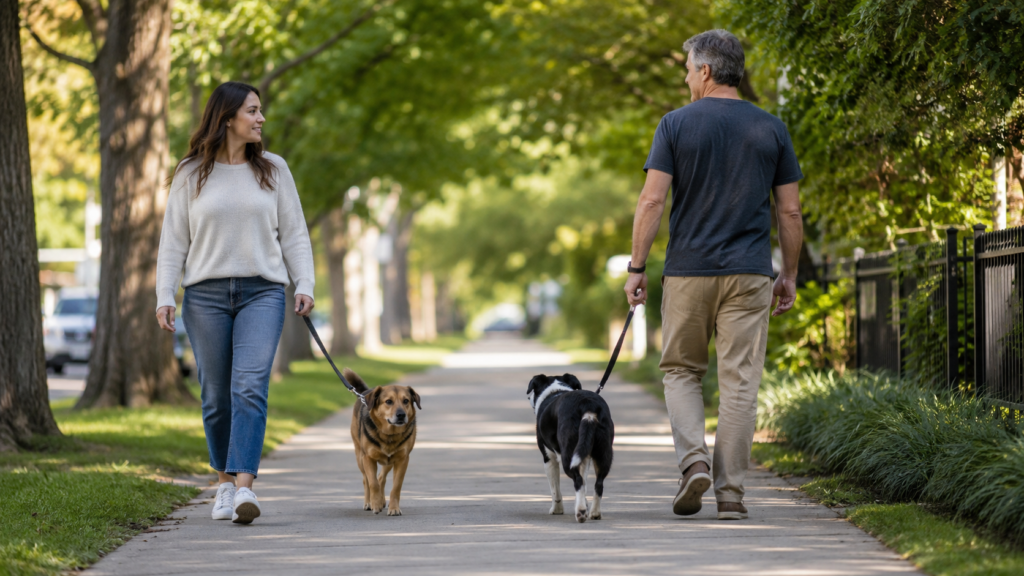
Walking calmly around other dogs — without greeting or interacting — teaches exactly the neutrality we’re building toward. A dog that learns to walk past other dogs without pulling or reacting is far more functional than one that expects to play with every dog it passes.
Professionally Supervised Training Classes
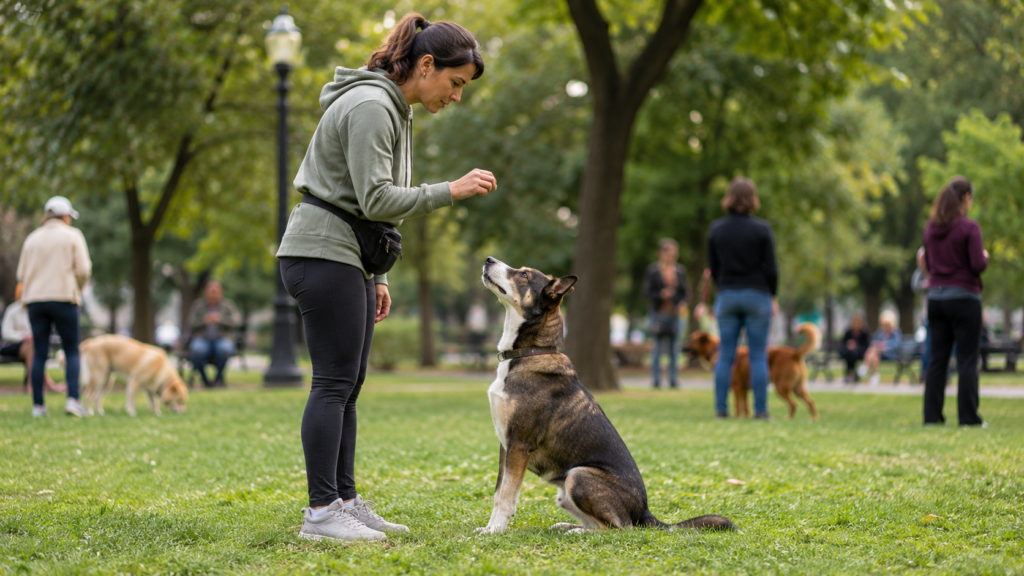
Structured classes allow dogs to learn around other dogs in a supervised, controlled environment where the trainer can redirect unhealthy dynamics before they become reinforced. This is one of the most productive forms of dog-to-dog socialization available.
Public Outings
Outdoor shopping areas, parks, and pet-friendly businesses provide excellent exposure to people, dogs, sounds, and environments without requiring any dog-to-dog interaction at all. Your dog is simply learning that the world is normal — which is the foundation of genuine confidence.
The One Exception
If you’re meeting with dogs you know well — and the owners are actively supervising the interactions — a fenced area can be a wonderful place for dogs to play. The difference is control. You know the dogs, you understand their personalities, you trust the owners, and everyone is paying attention and committed to keeping the interactions safe and appropriate.
That’s a fundamentally different situation from walking through the gate of a public dog park filled with unknown dogs and owners of varying attentiveness. Same fence, completely different risk profile.
A Note on Disease and Health Risk
Beyond the behavioral risks, dog parks carry real health concerns that are worth understanding — particularly for puppies and dogs that are immunocompromised or not fully vaccinated.
High-traffic fenced areas where many dogs eliminate accumulate pathogens in the soil and on surfaces that can transmit canine parvovirus, leptospirosis, kennel cough, intestinal parasites, and other conditions. Vaccination provides meaningful protection against many of these, but not all — and some diseases spread through contact with contaminated ground rather than direct dog-to-dog transmission. For puppies in particular, whose immune systems are still developing, the risk-to-benefit calculation of dog park visits deserves careful thought before the first visit.
Comparing the Options
| Option | Builds Confidence | Teaches Neutrality | Risk Level |
|---|---|---|---|
| Public dog park | Inconsistent | Often works against it | High — uncontrolled environment |
| Chosen playmates (known dogs) | Yes | Yes, with supervision | Low — you know the dogs |
| Structured walks near other dogs | Yes | Directly builds it | Low |
| Professional training classes | Yes | Yes, in structured setting | Very low — supervised |
| Public outings (no interaction) | Yes | Yes — passive exposure | Very low |
Frequently Asked Questions
Are all dog parks bad?
Not every visit ends badly — and we’re not suggesting dog parks are universally dangerous. What we’re saying is that public dog parks expose your dog to risks that are genuinely difficult or impossible to control, and that there are better ways to meet the same goals. The question isn’t whether bad things always happen there. It’s whether the risk-to-benefit ratio makes it the best choice available, and for most dogs, it isn’t.
My dog loves the dog park. Should I stop going entirely?
Many dogs do love dog parks — the freedom, the stimulation, and the social interaction are genuinely enjoyable for them. The question is whether that enjoyment outweighs the risks, and whether what they’re learning there is what you actually want them to learn. For most dogs, particularly those that are becoming reactive, selective, or difficult to manage around other dogs, reducing or eliminating dog park visits is often part of the solution rather than the problem.
How can I socialize my dog without a dog park?
Structured walks near other dogs, professionally supervised training classes, carefully selected playmates with known dogs, and regular exposure to new public environments all build confidence while minimizing unnecessary risk. These approaches tend to produce calmer, more focused dogs than dog park regulars — because they’re teaching neutrality rather than reinforcing excitement.
Should puppies go to dog parks?
We generally recommend against it, for two reasons. First, puppies are still developing socially and emotionally, and a single negative or overwhelming experience can have a lasting impact on how they relate to other dogs for years. Second, puppies who learn that every dog encounter leads to play become adolescents who expect the same — which is when the leash reactivity and frustration behaviors typically start showing up. Starting with structured, controlled socialization from the beginning produces significantly better outcomes.
My dog was attacked at a dog park and is now reactive. What should I do?
This is one of the most common histories we see in reactive dogs. A negative experience at a dog park — particularly during a sensitive developmental period — can create fear-based reactivity that takes real, systematic work to address. The good news is that it’s workable. Our adult dog training program addresses reactivity as a core component of the obedience work, and a free consultation is a good place to start understanding what a realistic plan would look like for your specific dog.
What if my dog seems fine at the dog park — no fights, no issues?
That’s genuinely good to hear, and it does happen. But “no visible conflict” is a lower bar than “building the habits I want.” The subtler concern is what your dog is practicing and learning during those visits — checking in with you or ignoring you, moving calmly or over-aroused, respecting other dogs’ space or rehearsing rude greetings. Even uneventful dog park visits can quietly undermine focus, recall, and leash behavior if they’re happening frequently enough.
Is Sniffspot a good alternative to dog parks?
Privately rented, fenced spaces can be a good middle ground when used carefully. The key advantage is that you control who else is there — you can go alone with your own dog, or arrange to bring a known, trusted playmate. That control makes a significant difference. The same fenced space that becomes unpredictable with ten unknown dogs becomes a very manageable environment with just your dog and one you know well.
Is Your Dog Struggling Around Other Dogs?
Whether your dog has become reactive after a bad experience, or you simply want to build the kind of calm, neutral confidence that makes every walk enjoyable, our adult dog training program addresses dog-to-dog reactivity as a core part of the work. Schedule a free consultation and let’s talk about what you’re seeing and what it would take to fix it.
Free Consultation