
Quick Summary
- A service dog is trained to perform specific tasks that mitigate a disability. An emotional support animal provides comfort through companionship, without task training.
- Only service dogs receive public access rights under the ADA — emotional support animals generally do not.
- Neither category requires federal certification, registration, or an ID card — anything sold online claiming otherwise has no legal authority.
- Misrepresenting a pet or ESA as a service dog is now illegal in most states and carries real consequences for legitimate service dog teams.
- The right choice depends on whether you need a dog trained to perform specific disability-related tasks, or a companion whose presence provides comfort.
If you’ve spent any time researching service dogs, emotional support animals, or disability accommodations, you’ve probably run into a lot of conflicting information. Can emotional support animals go into restaurants? Do service dogs need certification? Can any dog become a service dog?
It’s no surprise people get confused. One of the most common questions we receive at The Dog Training Institute is: “What’s the difference between a service dog and an emotional support animal?”
While both can play an important role in someone’s quality of life, they are not the same thing. They serve different purposes, require different training, and carry very different legal protections. Understanding that distinction matters — not just for dog owners, but for businesses, landlords, and the public as well.
The Short Answer
The simplest way to understand the difference: a service dog is trained to perform specific tasks that help mitigate a disability. An emotional support animal provides comfort through companionship, but is not trained to perform disability-related tasks.
Both can provide tremendous benefit. Only service dogs receive public access rights under federal law.
What Is a Service Dog?
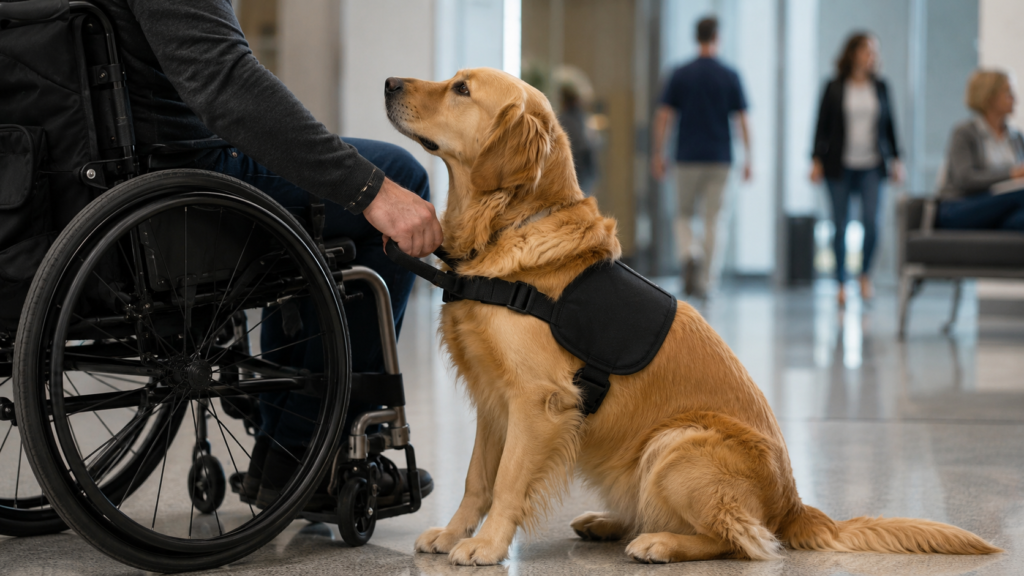
Under the Americans with Disabilities Act (ADA), a service dog is a dog individually trained to perform specific tasks directly related to a person’s disability. The key phrase is “individually trained to perform specific tasks” — the dog must actively do something that helps the handler manage their disability.
Examples include guiding individuals who are blind, alerting individuals who are deaf, retrieving dropped items, opening doors, assisting with mobility, alerting to medical conditions like seizures or blood sugar changes, interrupting panic attacks, and providing deep pressure therapy. The dog isn’t simply present for comfort — it performs trained behaviors that directly mitigate the disability.
What Is an Emotional Support Animal?
An emotional support animal, or ESA, provides comfort through companionship. Their presence alone may help reduce symptoms associated with anxiety, depression, PTSD, loneliness, or emotional distress.
Unlike service dogs, emotional support animals are not required to perform specific tasks and do not need specialized public-access training. Their benefit comes primarily from the comfort of companionship itself. Many emotional support animals are genuinely wonderful companions providing real therapeutic value — but that doesn’t make them service dogs under the law.
Why the Confusion Has Real Consequences
This isn’t just a matter of semantics. The confusion between these two categories has created a measurable problem for legitimate service dog teams.
A 2023 survey published in PLoS One found that 60% of emotional support animal owners admitted to falsely presenting their ESA as a service dog at least once, and 18% did so frequently or almost always — despite ESAs not meeting the legal criteria for service dogs. In response, 33 states had enacted bans on fraudulent service animal representation as of 2022, with more states continuing to pass similar legislation since.
This matters because fraudulent and untrained “service dogs” cause real harm. Canine Companions for Independence reported that roughly two-thirds of legitimate service dog users say poorly trained or fraudulent service dogs have negatively impacted their own independence and quality of life — through businesses growing suspicious of all service dogs, increased scrutiny, and even hostility toward people who genuinely need their dog’s support. Misrepresentation doesn’t just risk legal penalties for the person doing it. It makes life harder for people who depend on legitimate service dog access.
Why People Often Confuse the Two
Part of the confusion comes from the fact that both service dogs and emotional support animals may help people with the same underlying conditions. A person with PTSD may benefit from either. So may someone with anxiety or depression. The difference lies entirely in the dog’s training and function, not the handler’s diagnosis.
A psychiatric service dog may be trained to interrupt panic attacks, wake someone from nightmares, create space in crowds, alert to escalating anxiety, or perform specific grounding behaviors on command. An emotional support animal provides comfort simply through companionship — there’s no trained task involved. Both can be genuinely valuable. They are simply not legally or functionally the same thing.
Public Access Rights: The Most Important Distinction
This is where the difference becomes practically significant.
Service Dogs
Under federal law, service dogs are generally allowed to accompany their handlers into public places where pets aren’t normally permitted — restaurants, grocery stores, shopping centers, hotels, hospitals, public transportation, and government buildings. Because service dogs are trained to perform disability-related tasks and to behave appropriately in public, they receive these legal protections under Title III of the ADA.
Emotional Support Animals
Emotional support animals do not have the same public access rights. In most situations, businesses that prohibit pets are not required to allow ESAs onto the premises. This is where the most common and consequential misunderstandings happen — many people genuinely believe their ESA has the same access rights as a service dog. It does not, under federal law.
ESAs do have certain protections under the Fair Housing Act, allowing them to live with their owners in housing that otherwise restricts pets, and some protections in specific contexts. But general public access — restaurants, stores, transit — is not one of them.
Does a Service Dog Need Certification?
No. Under the ADA, there is no federally required certification, registration, or identification card for service dogs. In fact, many websites sell certificates, vests, and ID cards that have no legal significance whatsoever.
What actually matters: the handler has a qualifying disability, the dog is trained to perform tasks related to that disability, and the dog behaves appropriately in public. As service dog law specialists note, if someone presents a “certificate or ID card” to gain entry somewhere, that is itself often a signal the dog isn’t a legitimate service dog — because legitimate handlers know none is required. Under DOJ guidance, businesses may only ask two questions: whether the dog is a service animal required because of a disability, and what task it’s trained to perform. They cannot require documentation of any kind.
Do Emotional Support Animals Need Documentation?
There is also no official government certification for emotional support animals. However, individuals seeking ESA housing accommodations typically need documentation from a licensed healthcare provider supporting the need for the animal. Requirements vary by situation and jurisdiction — some states, including California, now require that the licensed mental health professional writing the letter have an established relationship with the patient of at least 30 days before issuing it, specifically to curb fraudulent letter-mill operations.
The Scope of the Fraud Problem
It’s worth understanding just how widespread this issue has become, because it shapes how businesses and the public respond to all service dogs — including legitimate ones.
CDC data from 2024 estimates that approximately 70 million Americans live with a disability, yet only about 1% have a service dog — a sharp contrast to the booming online market for fake certifications, vests, and registration cards. State legislatures have responded directly: as of recent counts, dozens of states have passed laws creating fines and penalties specifically for misrepresenting pets or ESAs as service dogs. Arkansas and California have gone further, requiring businesses that sell ESA or service dog products to disclose in writing that such items are not legally required.
The bottom line for anyone navigating this: no product, certificate, or registration makes a dog a service dog. Only legitimate task training tied to a disability does.
Side-by-Side Comparison
| Factor | Service Dog | Emotional Support Animal |
|---|---|---|
| Function | Trained to perform specific tasks that mitigate a disability | Provides comfort through companionship |
| Legal Definition | Recognized under the ADA | Not recognized under the ADA; some protection under the Fair Housing Act |
| Public Access | Generally allowed in restaurants, stores, transit, and other public places | Generally not allowed in places that prohibit pets |
| Training Required | Extensive task training plus public access reliability | No specific training requirement |
| Certification | None federally required | None federally required; housing letters may need licensed provider documentation |
| Housing Rights | Protected under Fair Housing Act | Protected under Fair Housing Act |
Can Any Breed Be a Service Dog?
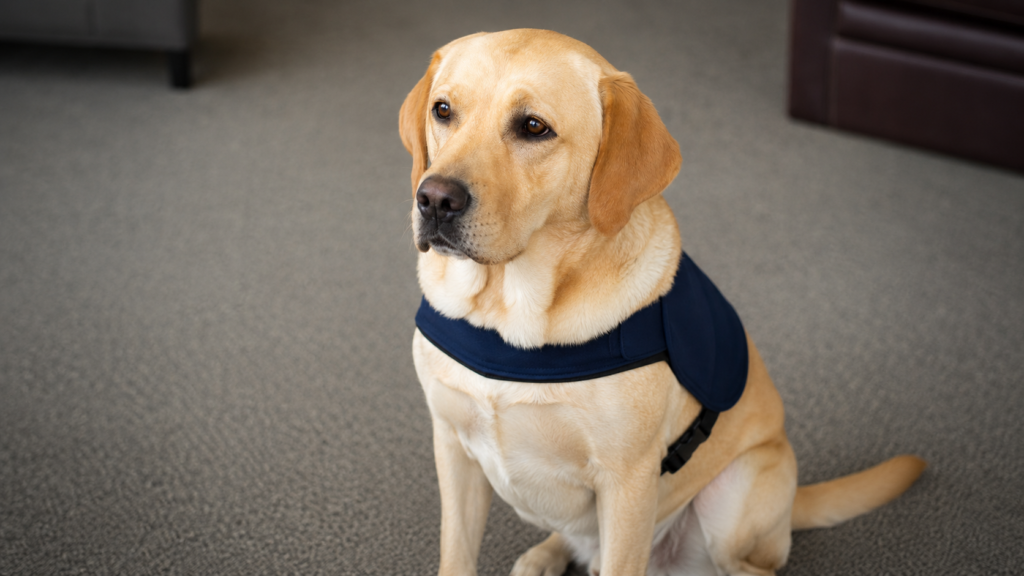
Many people assume only Labrador Retrievers or Golden Retrievers can be service dogs. While those breeds are common in professional programs, service dogs come in many breeds and sizes. The individual dog’s qualities matter far more than its breed.
Successful service dog candidates generally demonstrate confidence, emotional stability, trainability, strong focus, good physical health, and appropriate social behavior around people and other dogs. A dog that is well-behaved at home doesn’t automatically have what it takes for public access work — the standard for service dogs is considerably higher than the standard for a well-mannered pet.
What Is a Psychiatric Service Dog, Specifically?
Psychiatric service dogs are one of the fastest-growing categories of service dogs, trained to assist individuals with disabilities related to mental health conditions including PTSD, severe anxiety disorders, panic disorders, and certain forms of depression.
The key distinction from an ESA is that these dogs perform specific trained tasks rather than simply providing comfort — interrupting panic attacks, providing grounding behaviors on cue, creating personal space in crowded environments, guiding a handler to an exit during a crisis, or waking a handler from a nightmare. Because they perform trained tasks tied directly to a disability, psychiatric service dogs are considered legitimate service dogs under the ADA — unlike an ESA, regardless of how much comfort the ESA genuinely provides.
Why Some Dogs Don’t Make It Through Service Dog Training
Not every dog successfully completes service dog training, and that doesn’t mean the dog is bad — it means service work requires an exceptionally high and specific standard. Common reasons dogs don’t make it through include fearfulness, reactivity toward people or other dogs, anxiety in novel environments, environmental sensitivity, health concerns, or difficulty settling quietly in public for extended periods.
A dog that doesn’t succeed at service work can absolutely still be a fantastic companion or emotional support animal. The traits required for each role are genuinely different — and matching the right role to the right dog matters as much as the training itself.

Frequently Asked Questions
Can I train my own service dog?
In many situations, yes — the ADA allows owner-training. Professional guidance is strongly recommended to ensure the dog develops the reliability and public access skills genuinely necessary for service work, since the standard required is considerably higher than most owners initially expect.
Can a service dog be any breed?
Potentially, yes. The dog’s individual temperament, health, and trainability generally matter more than breed alone, though some breeds are more commonly successful due to their typical temperament and trainability.
Can an emotional support animal go into stores or restaurants?
Generally, no. Emotional support animals do not receive the same public access rights as service dogs under federal law. Individual businesses may choose to allow them, but they are not legally required to.
Do service dogs need to wear a vest?
No. While many handlers choose to use a vest for practical reasons or public clarity, federal law does not require one. A dog without a visible vest can still be a fully legitimate service dog.
Is a psychiatric service dog the same as an emotional support animal?
No. A psychiatric service dog performs specific trained tasks related to a disability. An emotional support animal provides comfort through companionship without trained task performance. The distinction is the training and function, not the underlying condition being addressed.
Does my dog need certification to be a legitimate service dog?
No. There is no federally required certification, registration, or ID for service dogs. Anything purchased online claiming to provide official certification has no legal authority and does not make a dog a service dog.
How can businesses tell the difference between a real and fake service dog?
Behavior is the primary indicator. Legitimate service dogs are trained to remain calm, focused, and well-behaved in public settings. Businesses are legally permitted to ask a dog to leave if it is acting aggressively, being disruptive, or is not housebroken — regardless of whether the handler claims it’s a service dog. Staff are also only permitted to ask the two questions allowed under the ADA, not request documentation.
If my dog doesn’t make it through service dog training, what happens?
They remain your dog. A dog that isn’t suited to service work isn’t a failure — they simply have a different calling. Many dogs that don’t complete service training make wonderful companions, emotional support animals, or excel in other roles entirely. If you’re unsure which path is right for your dog and your needs, a professional evaluation can help clarify the realistic options.
Not Sure Which Path Is Right for Your Dog?
Sean Knudsen has trained service dogs for over two decades and can give you an honest, experienced assessment of whether your dog is a strong service dog candidate — or whether a different path makes more sense. Schedule a free consultation and let’s talk through your specific situation.
Free ConsultationTags