
Quick Summary
- Most dogs don’t ignore recall because they’re stubborn — they’ve been accidentally taught that coming back isn’t worth it.
- Recall is less an obedience command and more a reflection of your relationship.
- The three most common mistakes: repeating the command until it loses meaning, calling when you can’t enforce it, and punishing the dog when they finally return.
- A long line is one of the most important tools in recall training — it prevents the dog from practicing ignoring you while reliability is still being built.
- A reliable recall is built through thousands of successful repetitions across gradually increasing levels of distraction — not shortcuts.
Few things are more frustrating than calling your dog and being completely ignored. You call their name. Nothing. You call again. Still nothing. Meanwhile your dog is happily chasing a squirrel, greeting another dog, or pretending you’ve suddenly become invisible.
If you’ve found yourself asking, “Why won’t my dog come when called?” — you’re not alone. It’s one of the most common training problems dog owners face. It’s also one of the most important to solve.
A reliable recall isn’t just a convenience. It can literally save your dog’s life. Whether your dog slips through an open gate, gets loose on a hiking trail, or heads toward a busy road, the ability to call them back immediately can prevent a tragedy. According to veterinary behavior specialists at UC Davis School of Veterinary Medicine, recall training is vital to keeping dogs safe in any off-leash situation — and no training is ever 100% reliable, which means precautions like leashes near traffic should always remain in place regardless of how solid the recall feels.
After training thousands of dogs over the last two decades, I’ve found that recall problems usually aren’t caused by stubbornness. They’re almost always caused by inconsistent training, unrealistic expectations, and unintentionally rewarding the wrong behaviors.
What “Reliable Recall” Actually Means
Notice one important word in the definition of a reliable recall: immediately.
A reliable recall doesn’t mean your dog comes eventually. It doesn’t mean they finish sniffing three bushes, greet another dog, and wander back when they feel like it. A reliable recall means your dog hears the cue, turns around, and comes directly to you — regardless of what’s happening around them.
That level of reliability takes time and a specific training approach to build. It also requires being honest about where your dog actually is in that process — which is where most owners run into trouble.
Why Dogs Stop Coming When Called
Most dogs aren’t born ignoring recalls. Young puppies naturally want to stay close. The problem is that owners often unintentionally teach them that coming when called isn’t a good deal.
Think about the situations when most people call their dog. Come — it’s time to leave the park. Come — bath time. Come — we’re going inside. Come — time to get your nails trimmed. Over time, the dog sees the pattern clearly: coming to the owner means the fun ends. Staying away means they get to keep doing what they enjoy. From the dog’s perspective, ignoring you becomes the better deal. And every time they ignore the recall and the fun continues, that choice is reinforced.
Recall Is Really a Test of Your Relationship
This may be the most important concept in this entire guide.
Most people think of recall as an obedience command. In reality, it’s a reflection of your relationship. When your dog sees another dog, a squirrel, an interesting smell, or a group of people, they are constantly making a choice: what is the most rewarding thing available to me right now?
If every distraction in the environment is more rewarding than coming back to you, recall will always be unreliable. This is why we spend considerable time building engagement and genuine value before expecting reliability at a distance. As Fenzi Dog Sports Academy notes, a dog with a solid recall has genuine safety and freedom — but that recall is built on a relationship, not just a command.
Dogs that genuinely enjoy interacting with their owners come back. Dogs that find the owner less interesting than the environment don’t. Building that value is the real work of recall training.
The Three Biggest Recall Mistakes Owners Make
Repeating the Command
This is the most common mistake we see. Owners call once. Then again. Then again louder. Eventually the word loses all meaning — the dog learns that the first few repetitions don’t require any response. Give the command once, then help the dog succeed. Repeating the command until you shout it turns your recall cue into background noise.
Calling When You Can’t Enforce It
Every time your dog ignores a recall and nothing happens, they’re practicing ignoring you. Training occurs whether you intend it to or not — every repetition matters. As Company of Animals’ training specialists note, off-leash training before reliability is established creates the exact self-rewarding experiences you’re trying to prevent. Until your dog’s recall is solid, only call when you can follow through.
Punishing the Dog After They Come Back
This one is particularly damaging and extremely common. The dog runs off. The owner gets frustrated. Eventually the dog comes back. The owner scolds them for taking so long, or grabs their collar roughly, or immediately ends the fun. The dog learns a simple, durable lesson: coming back causes unpleasant things to happen.
Even if your dog took ten minutes to return, praise them when they finally come. The correction belongs with the running away, not the return. Once they come back, it should always be a positive experience — no exceptions.
Building the Foundation: What Comes Before Distance and Distraction
Engagement First
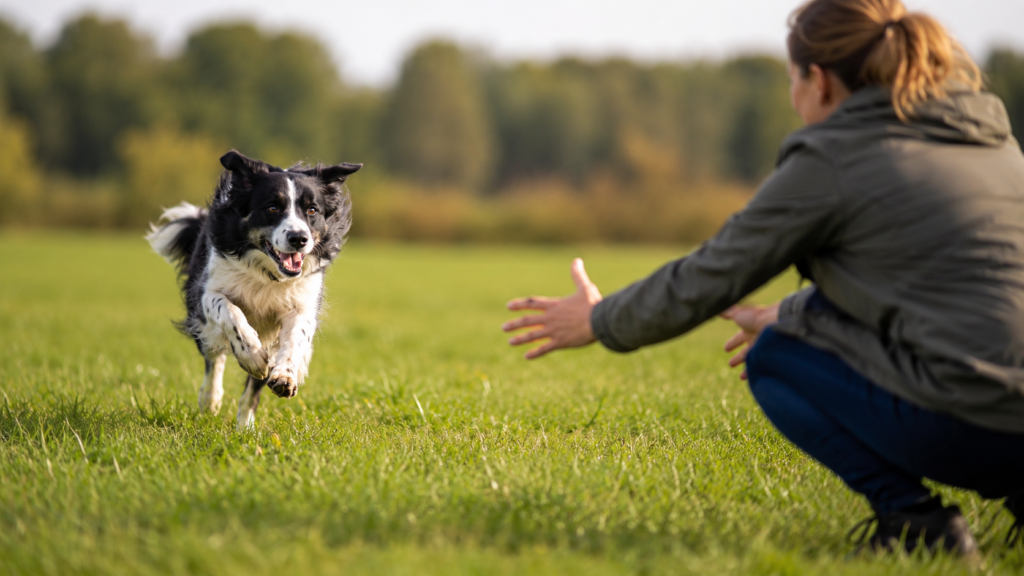
Before distance, before distraction, before off-leash freedom — comes engagement. A dog that pays attention to you is dramatically easier to train than a dog that doesn’t. The first goal is simple: teach your dog that paying attention to you is rewarding, following you is rewarding, and being near you is genuinely enjoyable. This creates the relationship where recall becomes natural rather than forced.
Build Real Value
Many owners expect their dogs to come because they were told to. Dogs don’t think that way. You have to become worth coming back to — through food, play, praise, excitement, and adventure. The more value you create in the dog’s mind, the easier every aspect of recall becomes. Dogs repeat behaviors that produce good outcomes. Make returning to you consistently produce the best outcome available.
The Thrown Recall Game
One of the most effective ways to build recall drive early is a simple game. Start in a low-distraction environment. Throw a piece of food a short distance away and let your dog run to get it. As they go, begin moving away in the opposite direction. When they finish eating and look up, get their attention with excitement — clap, make noise, make yourself interesting. The moment they commit to moving toward you, mark the behavior and reward generously. Then repeat.
This game teaches your dog that returning to you creates more fun, not less. It builds the chase instinct in the right direction — toward you rather than away — and does it while the dog is happy and engaged rather than being drilled on commands.
The Three D’s of Recall Training
A reliable recall is built by systematically working through three variables. Rushing any of them is one of the most common reasons recall training stalls.
| Variable | What It Means | Common Mistake |
|---|---|---|
| Distance | How far away the dog is when you call | Starting from across the yard before reliability at close range is established |
| Duration | How long the dog stays focused and responsive over a training session | Reducing rewards too quickly before the behavior is truly solid |
| Distraction | The level of competing stimuli in the environment | Moving from a quiet living room to a busy dog park without gradual steps in between |
The key is gradual progression on each variable — only increase one at a time. A dog that comes reliably in the backyard at 10 feet is not ready for off-leash recall at a busy park. Success at each level builds the confidence and habit needed for the next one.
Why Your Dog Listens Inside But Not Outside
This is one of the most common complaints we hear. The answer is straightforward: the environment changes completely. Inside, there are few competing distractions. Outside there are smells, dogs, people, squirrels, cars, birds, and sounds all competing for your dog’s attention at once.
Your dog isn’t being stubborn. The distractions have simply become more rewarding than you are in that moment. A dog that comes perfectly in the kitchen hasn’t learned recall — they’ve learned recall in the kitchen. The behavior needs to be trained progressively across environments, not expected to transfer automatically.
Using a Long Line: The Most Underused Recall Tool
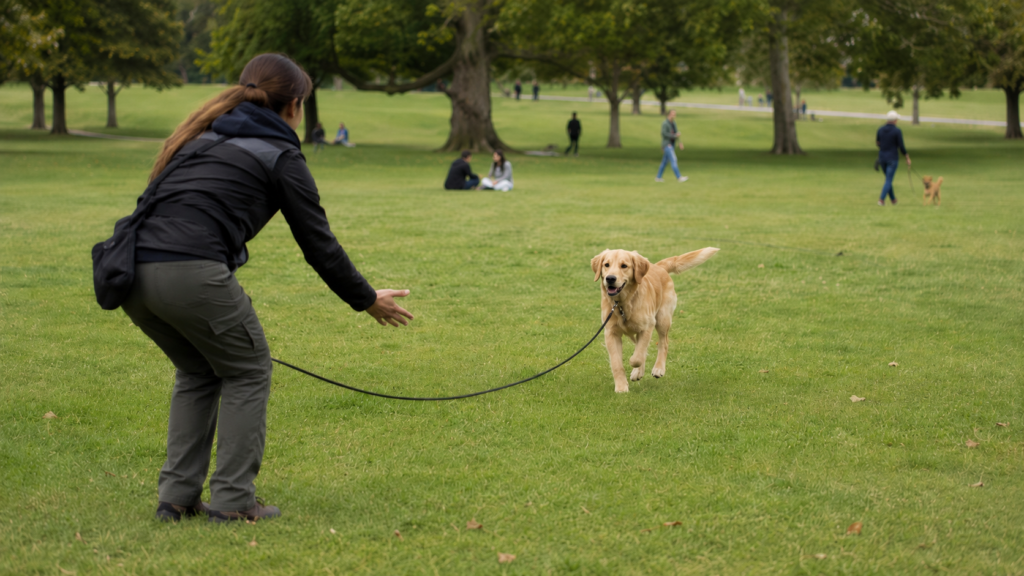
A long line — typically 15 to 30 feet — is one of the most valuable tools in recall training and one of the most frequently skipped. Think of it as a safety net that allows your dog freedom of movement while preventing them from practicing ignoring you.
With a long line you can increase distance safely, build confidence through successful repetitions, and — critically — prevent the self-rewarding failures that happen when a dog blows off a recall and continues doing whatever they wanted. Behavior specialists consistently note that many owners remove the long line too early and discover their dog’s recall falls apart the moment the safety net is gone. The long line bridges the gap between controlled practice and genuine off-leash reliability — and that gap often takes weeks or months to close, not days.
Adolescence: When Recall Often Gets Worse Before It Gets Better
If your previously responsive puppy has suddenly started ignoring recalls, you’re likely hitting adolescence — roughly 6 to 18 months depending on the breed. During this period, hormonal changes increase independence and environmental interest. Recall often deteriorates even in dogs that seemed reliable beforehand.
This is normal. The answer is not less reinforcement — it’s more. Maintain training consistency, keep reward value high, go back to easier environments if needed, and don’t interpret the regression as failure. Adolescence is the stage where consistent owners separate from inconsistent ones. The dogs that come out the other side with reliable recalls are almost always the ones whose owners didn’t reduce expectations or effort during the hard months.
Common Recall Problems and How to Fix Them
My dog only comes when I have food visible
This usually means rewards haven’t been varied enough and the dog has figured out the pattern. Mix in praise, toys, play, freedom to go sniff, and access to things they enjoy — not just food. You want the dog to believe good things happen when they come to you, without being able to predict exactly what those things will be. Unpredictable rewards are actually more powerful than consistent ones once the behavior is established.
My dog comes halfway, then leaves
This almost always means the dog is uncertain about what happens when they fully arrive. Something about the completion — collar grab, leash clip, end of play — has become mildly aversive. Make arrival wildly rewarding every single time. Practice touching the collar and immediately rewarding with no consequence following. Don’t only grab the collar when the fun is ending.
My dog runs away when I reach for his collar
This is a very common pattern that owners accidentally create. Practice collar touches frequently in low-stakes situations — touch the collar, give a treat, release. Do this dozens of times with no consequence following. The collar grab needs to be associated with good things, not the signal that freedom is ending.
My dog is perfect at home but completely ignores me outside
Go back to basics and build progressively. Start in your backyard, then the front yard, then a quiet street, then a slightly busier area, then a park at a quiet time, then a park with more activity. Each environment is a new training context. Don’t skip steps because your dog “knows” recall — they know it in the environments where they’ve practiced it.
Frequently Asked Questions
At what age should I start recall training?
Immediately — even young puppies can begin learning simple recall games and engagement exercises. The earlier you start building value for coming to you, the more of that history you have when adolescence hits and the going gets harder. Waiting until a puppy is 6 months old to start recall training means months of missed opportunity to build the habit.
Can an older dog with bad recall habits learn to come reliably?
Yes, though it takes more time and consistent management than starting from scratch with a puppy. Adult dogs with years of ignoring recalls have to unlearn an established pattern before the new behavior can take hold. Be patient, be consistent, use a long line, and don’t expect the timeline to be the same as it would be with a young puppy.
Should I use food rewards forever?
Not necessarily in the same way as during the learning phase. Food is powerful for building the behavior initially. As training progresses and reliability improves, rewards become more varied and less predictable — which is actually more motivating than consistent food delivery. The goal is a dog who comes because good things happen, not because they can see food in your hand.
Why does my dog come perfectly inside but completely ignore me outside?
Because they’ve learned recall in one environment, not recall as a generalized skill. Outside has exponentially more competing distractions, and the dog’s internal calculus changes. This is normal and expected — it means you need to train the behavior in progressively more distracting environments, not that your dog is broken or stubborn.
How long does it take to build a reliable recall?
It varies significantly based on the dog’s age, breed tendencies, training history, and how consistent the owner is. Some dogs show dramatic improvement within weeks of structured training. Others — particularly adult dogs with long histories of ignoring recalls, or breeds with strong independent drives — may take many months of consistent work. Reliability is built through thousands of successful repetitions, not dozens.
Is it ever too late to fix a bad recall?
Rarely. We’ve worked with dogs of all ages who came in with essentially no recall and developed reliable responses with time and consistent training. The older the dog and the longer the habit has existed, the more patient and systematic you need to be — but the same principles apply at any age.
My dog comes when I call them in most situations but not around other dogs. Help.
Other dogs are one of the highest-value distractions for most dogs. The answer is working systematically at distance from other dogs — far enough away that your dog can still choose you — and rewarding heavily for that choice. Gradually close the distance over many sessions as reliability builds at each step. Trying to call your dog off another dog before that foundation exists is setting both of you up to fail.
Should I use a different word if my dog’s recall is already poisoned?
Sometimes, yes. If you’ve spent months calling “come” while the dog ignores you, that word has already been conditioned to mean “optional.” Starting fresh with a new cue — and protecting that new cue by never using it when you can’t enforce it — can be more effective than trying to rebuild the original word. Whatever cue you use, guard it carefully.
Want a Dog You Can Actually Trust Off Leash?
Reliable recall and off-leash obedience are core parts of our adult dog training program. We work with only 2 dogs per trainer at a time in a real home environment — building the engagement, focus, and reliability that make off-leash freedom something you can actually feel confident about. Schedule a free consultation and let’s talk about where your dog is and what it would take to get there.
Free Consultation