
Quick Summary
- Puppy biting is completely normal — it is how puppies explore the world and communicate.
- The most intense biting phase typically peaks between 8 and 20 weeks, then improves significantly around 6 months as teething wraps up.
- One of the most overlooked causes of biting is an overtired puppy, not an over-energized one.
- Punishment rarely works and often makes things worse — redirection and structure are far more effective.
- Crate training, impulse control exercises, and consistent supervision are the three tools that move the needle most.
If you’ve recently brought home a puppy, chances are you’ve already felt those needle-sharp teeth on your hands, ankles, pant legs, or all three at once.
One minute they’re sweet and cuddly. The next they’re hanging off your sleeve, going after your children’s feet, and treating every moving thing in the house as a target.
If you’ve found yourself asking, “Why won’t my puppy stop biting?” — you’re in good company. It’s one of the most common concerns we hear from new puppy owners, and fortunately, it’s also one of the most solvable.
After training thousands of dogs over the last two decades, I’ve found that most puppy biting problems aren’t caused by bad puppies. They’re caused by misunderstanding normal puppy behavior and not providing enough structure, supervision, and appropriate outlets.
Here’s what’s actually going on — and what to do about it.
Is Puppy Biting Normal?
Yes, completely. Biting is one of the primary ways puppies interact with the world. They don’t have hands. They explore, investigate, play, and learn through their mouths — and that instinct doesn’t switch off just because they’ve moved into your living room.
When puppies play with their littermates, they bite. When they investigate new objects, they bite. When they’re excited, frustrated, or tired, they bite. Mouthing is a normal part of puppy development across every breed.
The goal isn’t to eliminate biting overnight. The goal is to teach your puppy what’s appropriate to bite — and what isn’t.
Why Puppies Bite So Much: The Real Causes
Teething
Puppies go through two teething phases. The first happens between 3 and 6 weeks while still with their mother. The second — and most intense — begins around 12 weeks and runs through 24 weeks as the adult teeth emerge. According to Vetster’s veterinary team, this process causes real gum discomfort, and chewing provides relief.
As dental development specialists note, the window between 16 and 24 weeks — when canine teeth and premolars erupt — is often the most intense chewing phase, with gums inflamed and the urge to bite at its peak. By 6 to 7 months, all 42 permanent adult teeth should be in place and the worst of teething is behind you.
During this window, if it exists in your house, your puppy will probably try to chew it. Shoes, furniture, cords, children’s toys, table legs — nothing is off limits from their perspective. Providing appropriate chew toys during this period isn’t optional. It’s essential.
Play Drive
Many puppies bite simply because they want to engage. This is how puppies naturally interact with one another — through mouthy, physical play. The problem is that human skin is far more sensitive than puppy skin. What feels playful to your puppy can be genuinely painful to you, especially with those razor-sharp baby teeth.
Excitement and Arousal
Have you noticed your puppy gets more mouthy when visitors arrive? When children are running around? When everyone is laughing and moving quickly? High arousal states make self-control much harder for young puppies. The more excited they become, the harder it is for them to regulate their own behavior — and biting is often the result.
The Cause Most Owners Miss: Overstimulation and Not Enough Sleep
This is one of the most important things to understand about puppy biting, and it’s something most owners never connect.
Many puppies aren’t biting because they have too much energy. They’re biting because they’re exhausted.
Young puppies need 18 to 20 hours of sleep per day. As Instinct Dog Training explains, much like a human toddler, puppies get fussy and cranky when they are tired — but they don’t yet have enough self-awareness to recognize they need to rest.
When a puppy stays awake past their limit, their body releases cortisol and adrenaline to keep them going. This looks like the “zoomies,” manic biting, or an inability to respond to any cues. According to veterinary behaviorists, it looks like too much energy — but it’s actually a stress response. The puppy has hit their cognitive limit.
Puppies will not put themselves to bed. Like toddlers, they need to be put down for naps. If your puppy is spinning out — biting hard, doing zoomies, ignoring everything you say — the first question to ask is: when did they last sleep?
Why Punishment Usually Makes It Worse
When puppies bite, many owners instinctively reach for correction: yelling, tapping the nose, holding the muzzle shut, or physical reprimands. These approaches are understandable — it hurts, and the reaction feels natural. But they tend to backfire.
Your puppy isn’t challenging your authority. They’re behaving like a puppy. Punishment in this context often increases anxiety, frustration, and arousal — which are three of the very things that drive biting in the first place. Rather than teaching your puppy what to do instead, it simply adds stress to an already overstimulated dog.
Instead of teaching your puppy what not to do, focus on teaching them what you want them to do. That creates clarity — and clarity creates faster learning.
What Actually Works: A Practical Approach
Management First
One of the core principles we teach is that management prevents problems. The more your puppy practices biting people, the better they get at biting people. The more they practice chewing appropriate toys, the better that habit becomes. Your job is to control what your puppy gets to rehearse.
This means supervising closely, limiting unsupervised freedom, and keeping appropriate outlets within reach at all times. Every session where your puppy bites hands and nothing productive happens is a missed opportunity to build the right habit.
Redirect to Appropriate Chew Toys
The moment biting starts on something inappropriate, redirect immediately to something appropriate. Keep chew toys in every room. Good options include rubber chew toys, puppy-safe teething toys, stuffed food toys, frozen chews, and durable puppy bones. The goal isn’t to simply stop the behavior — it’s to give the behavior somewhere acceptable to go. Chewing is a need. Your puppy requires an outlet for it.
Use Structured Play Sessions
Many biting problems exist because puppies have no productive channel for their energy. Structured play helps satisfy natural drive. Tug games, fetch, food games, scent work, and training sessions all provide appropriate outlets — with training being particularly valuable because it engages both body and mind. Mental exercise often tires puppies faster than physical exercise alone, and a tired puppy in the right way is a calmer puppy.
Teaching Impulse Control
If there’s one skill that improves puppy behavior more than any other, it’s impulse control. Most puppies know what you want from them. They simply struggle to do it when they’re excited. This is why puppies jump on guests, pull on the leash, chase things, and bite during play. The problem usually isn’t a lack of knowledge — it’s a lack of self-regulation.
Teaching simple exercises — sit, down, place, stay, wait — builds the mental muscle your puppy needs to pause before reacting. Over time, that self-control begins showing up everywhere, including in biting behavior.
When Your Puppy Bites Your Hands
This is the most common complaint. The solution is consistent, boring consequences. The moment biting starts: stop all interaction, become completely uninteresting, and redirect to a toy. Resume play only when appropriate behavior returns. If biting consistently ends the fun, puppies learn quickly that biting doesn’t produce the result they want. Consistency is everything here — hands are either always appropriate or never appropriate. Mixed messages slow the learning significantly.
Crate Training and Puppy Biting
Many owners think of the crate as purely a potty training tool. In reality, it’s one of the most effective solutions for puppy biting as well.
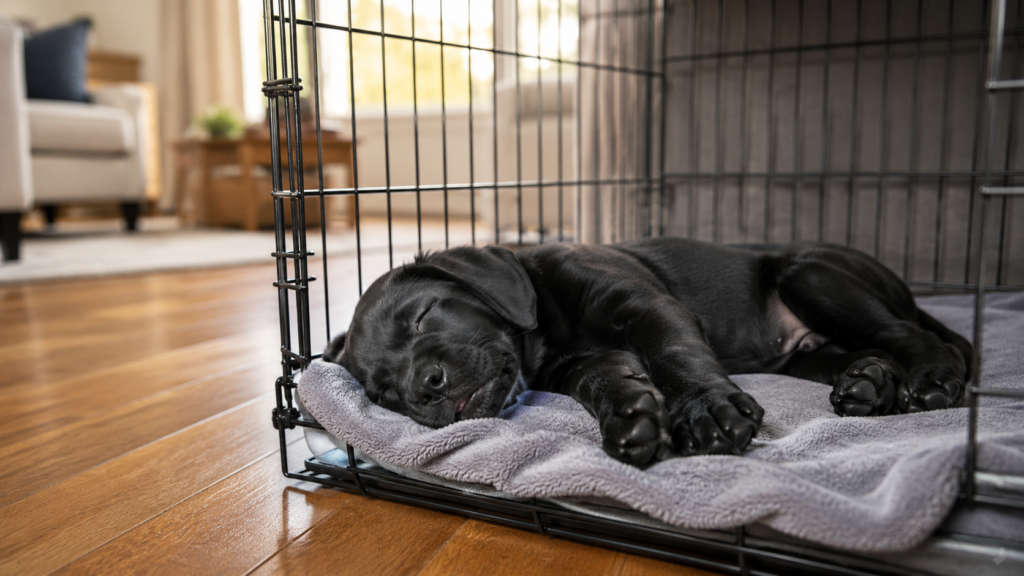
When a puppy becomes overtired and mouthy, a properly introduced crate gives them somewhere to decompress and recharge. Behavioral research suggests that establishing a routine of roughly one hour of activity followed by two hours of crate rest is one of the best ways to break the cycle of overstimulation. Many owners are genuinely surprised when their “out of control” puppy wakes up from a crate nap calm and responsive. The biting wasn’t caused by too much energy. It was caused by too little rest.
If your puppy is awake, actively biting, and clearly not able to settle — it’s nap time. Put them in the crate. They will not put themselves to bed, and they won’t thank you in the moment, but they’ll be a different dog when they wake up.
A Note About Children and Puppy Biting
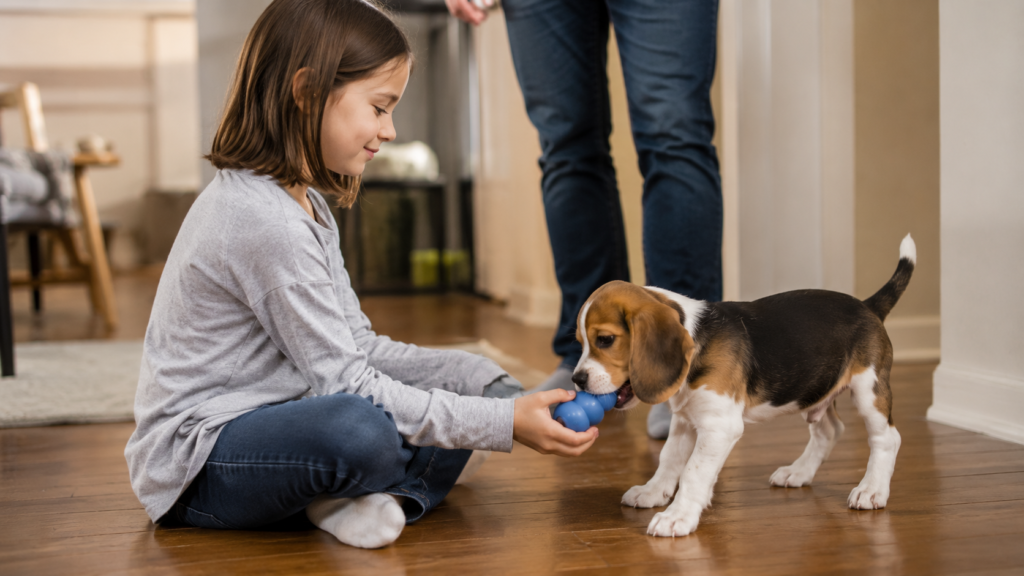
Puppies often become especially mouthy around children. Fast movements, squealing, and running trigger chase and bite responses — it’s pure instinct. Children should be taught not to run from the puppy, not to wrestle or encourage rough play, and how to redirect to toys instead of hands.
All interactions between young children and puppies should be actively supervised. This protects both the child and the puppy while good habits are still being built — and it prevents the accidental reinforcement of biting that happens when children react excitedly to being nipped.
When Is Puppy Biting Actually a Problem?
Most puppy biting is normal. But there are situations where professional input is worth seeking sooner rather than later. Consider reaching out if your puppy shows aggression around food or toys, bites with unusual intensity that seems beyond normal play, displays fear-based behavior alongside the biting, causes repeated injuries, or becomes increasingly reactive over time rather than improving.
True aggression in young puppies is relatively rare — it’s usually accompanied by stiff body language, resource guarding, or snarling that looks distinctly different from playful mouthing. Most of what owners describe as “aggressive biting” is either normal play drive or an overtired, overstimulated puppy who needs a nap. But when in doubt, having a professional assess what you’re seeing is always the right call.
How Long Does Puppy Biting Last?
The most intense biting phase typically peaks between 8 and 20 weeks, then begins to decrease significantly around 6 to 9 months as adult teeth finish coming in and emotional regulation improves. Most puppies show meaningful improvement by 6 months with consistent training and management.
That said, age alone doesn’t solve the problem. The puppies that improve fastest are the ones whose owners provide structure, enforce routines, use the crate appropriately, redirect consistently, and focus on impulse control from the beginning. Puppies who are left to figure it out on their own — with lots of freedom and inconsistent responses — often continue biting well past the teething phase because the habit has been reinforced.
Frequently Asked Questions
Why does my puppy bite me but not my spouse?
Puppies tend to bite most the people who interact with them most, or who produce the most exciting reactions. If you yelp, laugh, or engage actively when bitten, that response can reinforce the behavior. Consistency matters — everyone in the household should respond the same way.
Should I let my puppy chew on my hands?
No. Consistency is everything here. If hands are sometimes toys and sometimes not, your puppy receives mixed messages that slow the learning process considerably. Hands should never be appropriate chew objects — redirect to a toy every single time without exception.
Will my puppy outgrow biting on their own?
Many puppies do improve with age and teething completion, but training and management still matter. Puppies that are allowed to rehearse biting without consistent redirection often carry the habit past the teething phase because it has been reinforced so many times. Age helps, but it doesn’t do the work for you.
Is my puppy being aggressive?
In most cases, no. Normal puppy mouthing and play biting are very different from true aggression. True aggression typically involves stiff body posture, snarling, growling over resources, or biting that seems targeted and fearful rather than playful and aroused. If you’re unsure, a professional assessment is worthwhile — but most puppy biting falls firmly in the “normal development” category.
Does crate training really help with biting?
Significantly, yes. Many biting problems are rooted in overstimulation and sleep deprivation rather than a training deficit. The crate provides enforced rest during those windows, which is often the single fastest fix for a puppy that seems out of control. An overtired puppy that won’t listen to anything you say will often wake up from a crate nap as a completely different dog.
How much exercise does my puppy actually need?
Less than most owners think. A simple guideline is about one minute of leash walking per week of age — so an 8-week-old puppy needs roughly an 8-minute walk. More is not always better and can contribute to the overstimulation cycle. Short, structured play sessions combined with training and adequate rest tend to produce far better behavior than long, exhausting exercise sessions.
My puppy bites hardest in the evening. Why?
This is extremely common and has a name among trainers: the “witching hour.” It almost always comes down to accumulated fatigue and overstimulation throughout the day. By evening, the puppy has hit their limit, cortisol is elevated, and self-control goes out the window. The fix is usually more structured rest throughout the day — not more exercise or stimulation in the evening. A consistent bedtime routine that includes a crate nap earlier in the day often eliminates the witching hour almost entirely.
Should I yelp to stop my puppy from biting?
This is often recommended, but in our experience it produces mixed results. Some puppies do respond by backing off. Others become more excited by the noise and bite harder. If the yelp method isn’t working for your puppy after consistent attempts, stop using it and switch to the “become boring and redirect” approach instead. What matters is consistency, not which specific technique you use.
Want a Puppy That’s a Joy to Live With?
Biting, jumping, and poor impulse control are some of the most common things we address in our puppy training program. We work in a real home environment — not a large kennel facility — with only 2 dogs per trainer at a time, so every puppy gets the focused attention and structure they need to build lasting habits. Schedule a free consultation and let’s talk about what your puppy needs.
Free Consultation