
Quick Summary
- Dogs jump because jumping worked — it earned attention, eye contact, or physical contact at some point, and they’ve been repeating what works ever since.
- Even negative attention (pushing away, saying no) can reinforce jumping if the dog finds any interaction rewarding.
- The solution isn’t teaching “no jumping” — it’s teaching an incompatible behavior (like sitting) that earns the same reward jumping used to provide.
- Consistency across everyone in the household and every visitor is non-negotiable — one person rewarding the behavior undoes the work of everyone else.
- Jumping isn’t stubbornness or disrespect — it’s excitement looking for an outlet. Redirect it correctly and it resolves quickly.
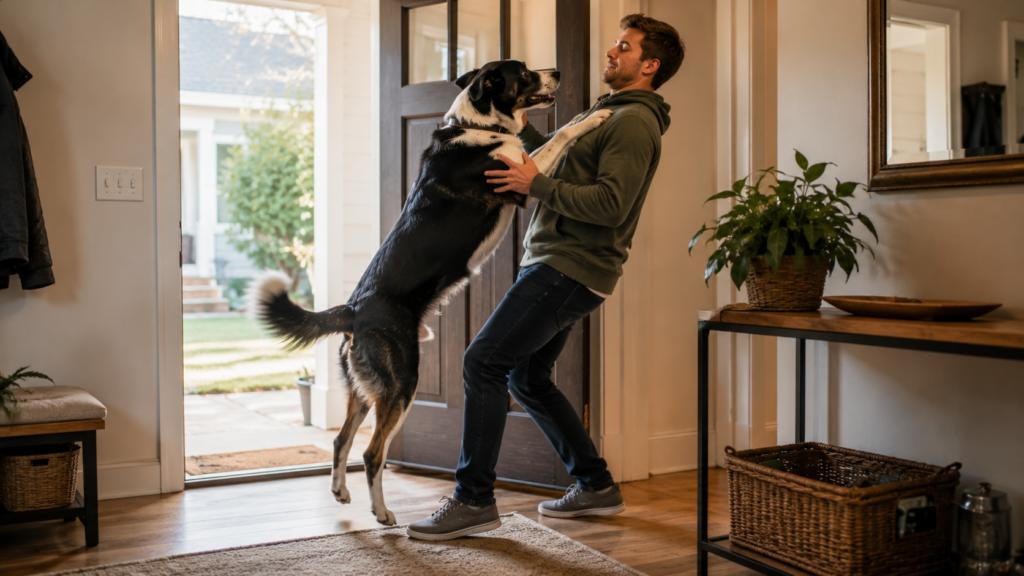
There’s nothing quite like coming home to a dog that’s thrilled to see you. Unfortunately, that enthusiasm often comes with muddy paws on your clothes, scratched arms, or a dog that launches itself at every visitor who walks through the front door.
Jumping is one of the most common behaviors dog owners struggle with — and also one of the most misunderstood. The good news is that once you understand why dogs jump, solving it becomes straightforward.
Why Jumping Matters Beyond the Inconvenience
Jumping isn’t just annoying — it carries real physical risk, particularly for certain groups. According to a 2024 study in the Journal of Veterinary Behavior, jumping on people is one of the most frequent problematic dog behaviors reported by owners. Dog nails can rip human skin and cause wounds, and large dog breeds can easily knock over elderly adults, small children, or individuals with mobility challenges — in a head-on collision, even causing a concussion. Beyond physical injury, many adults and most children are genuinely afraid of dogs, and a jumping dog that sees a frightened person back away has just been reinforced to repeat the behavior.
Teaching polite greetings isn’t just about etiquette. It’s about making your dog safe and accessible to everyone they’ll encounter.
Why Dogs Jump: The Simple Truth
Dogs don’t jump because they’re trying to dominate you or be disrespectful. They jump because they’re excited — and because somewhere along the way, jumping worked.
People are interesting to dogs. We talk to them, make eye contact, pet them, and greet them with energy. From the dog’s perspective, jumping is simply the fastest route to getting closer to your face and your attention. The behavior gets started because it produces results, and it keeps going because it continues to produce results — even inconsistently.
This is one of the most important things to understand about jumping: even negative attention can reinforce it. If your dog jumps and you push them away while talking to them, you’ve still interacted with them. To many dogs, any interaction is rewarding enough to keep trying.
Behavior That Gets Rewarded Gets Repeated
Imagine your dog jumps on ten different people. Nine ignore them completely. One bends down, pets them, and says “oh it’s okay, I don’t mind.” Your dog doesn’t average those experiences or remember the nine people who ignored them. They remember the one person who made jumping pay off.
That one successful attempt is often enough to keep the behavior alive indefinitely. This is why inconsistency is the single biggest obstacle to fixing jumping — and why the fix requires everyone in the picture, not just the primary owner, to respond the same way.
The Fix: Teach What to Do Instead
One of the most common mistakes owners make is focusing entirely on stopping the jumping — saying no, pushing the dog away, turning their back — without ever clearly communicating what they want the dog to do instead.
Start by asking yourself: What would I actually like my dog to do when someone arrives? For most families, the answer is simple: sit, or at minimum, keep four paws on the floor. A dog cannot sit and jump at the same time — teaching a solid sit as the default greeting behavior gives the dog an incompatible alternative that earns the same reward jumping used to provide.
The practical approach when guests arrive:
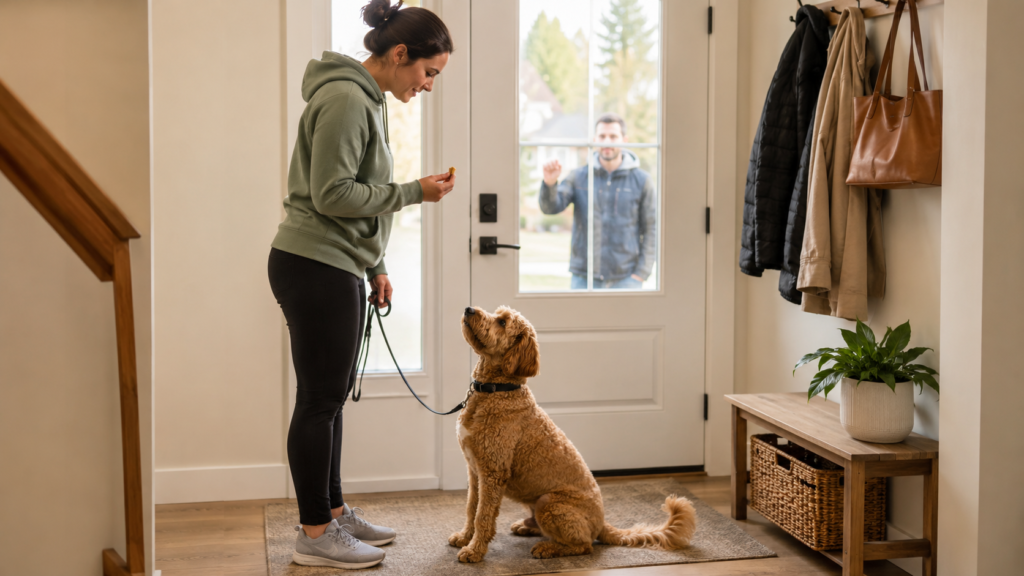
- Ask your dog to sit before the door opens
- Reward the sit with calm praise
- Ask visitors to greet only while all four paws remain on the floor
- If jumping occurs, remove attention immediately — turn away, no eye contact, no talking
- The moment four paws return to the floor, calmly reward with attention
Very quickly, the dog learns that sitting — not jumping — is what earns the greeting they want. The behavior shifts not because jumping was punished, but because an alternative was made consistently more rewarding.
Excitement Is the Real Challenge
Many dogs know how to sit perfectly in a low-distraction environment. Until the front door opens. Excitement changes everything — arousal overrides trained behavior when a dog hasn’t practiced performing that behavior under exciting conditions specifically.
This is why teaching “sit” in the kitchen isn’t enough on its own. The dog needs to practice maintaining their sit when exciting things are happening — a guest approaching, a doorbell ringing, someone crouching down to greet them. Each of those elements is a distraction that needs to be trained through, not assumed to be covered by practicing in calm settings.
Start by practicing with family members before expecting success with strangers. Have someone knock on the door multiple times in a session. Each time, work the routine — sit, reward calm, greet only on the floor. Short, successful sessions build the habit far more efficiently than waiting for real visitors to arrive and trying to figure it out in the moment.
Don’t Teach Your Dog That Rules Only Apply to Some People
One of the most common patterns we see is owners who allow jumping on family members — “he’s just saying hi” — but expect the dog not to jump on guests. From the dog’s perspective, that’s a confusing and inconsistent rule.
Dogs don’t naturally generalize that jumping is acceptable on one person but not another. They learn that jumping sometimes earns a response and sometimes doesn’t — which is actually harder to extinguish than a behavior that never worked at all. If jumping isn’t appropriate on guests, it shouldn’t be appropriate on anyone. Clear, consistent rules produce clear, consistent behavior.
The Energy You Bring to Greetings Matters
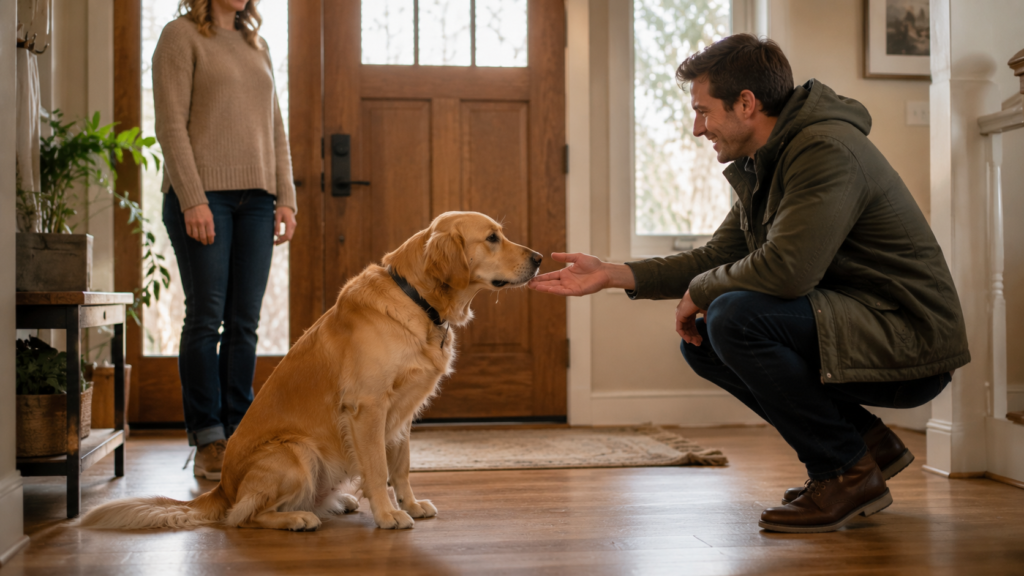
Many greetings accidentally create the very excitement owners are trying to calm down. High-pitched voices, rapid movement, crouching and making eye contact before the dog has settled — these all signal to the dog that this is a high-energy moment that warrants high-energy behavior.
Dogs often mirror the energy of the people around them. If you come through the door with high excitement and immediately engage your jumping dog, you’ve confirmed that arrivals are exciting events worth jumping over. Calm, matter-of-fact arrivals — greeting your dog only once they’re settled, speaking in a neutral tone, keeping movement slow — communicate that greetings are pleasant but unremarkable. That’s the energy that produces a dog who is happy to see you without launching themselves at you.
Everyone Needs to Follow the Same Rules
This is the piece that derails more jumping training than any other. If one family member rewards jumping while another corrects it, the dog receives inconsistent feedback — and inconsistent reinforcement is actually very durable, because the dog keeps trying based on the times it worked.
The same applies to visitors. Don’t hesitate to politely brief guests before they greet your dog: “Please wait until she’s sitting before you pet her.” Most people are happy to help once they understand — and the few who aren’t can be managed by keeping the dog on leash during greetings until their behavior is reliable enough not to require the same management.
A Note on Puppies and Starting Early
Puppies jump naturally — they’re small, curious, and excited, and the behavior is endearing when they weigh 12 pounds. The problem is that the same behavior at 70 pounds is dangerous, and habits formed in puppyhood are significantly harder to break later. Teaching polite greetings from day one is far easier than trying to undo a years-long jumping habit in an adult dog.
Many owners make the mistake of allowing jumping in puppies because it seems harmless or cute, then being surprised when the behavior continues into adulthood. If four paws on the floor is the expectation, it should be the expectation from the first day the puppy comes home. Our puppy training program addresses greeting behavior as part of the foundational work precisely because preventing the habit is so much more efficient than correcting it later.
How Long Does It Take?
With consistent application of the approach above, most dogs show meaningful improvement within one to two weeks. The timeline depends heavily on how long the jumping has been reinforced, how consistently everyone in the household applies the new approach, and whether the dog has an alternative behavior (like sit) that’s been clearly rewarded.
Dogs that have been jumping for years have a deeply ingrained habit — it won’t disappear in a single session. But with consistent structure, clear communication, and an incompatible behavior to replace it, the behavior shifts reliably. Every successful greeting where the dog sits and gets rewarded is one more repetition building the new habit.
Frequently Asked Questions
Should I knee my dog in the chest to stop jumping?
No. Physical corrections like kneeing can cause pain or injury, and they don’t teach the dog what to do instead — they just suppress the behavior in that moment without providing an alternative. Some dogs become anxious or defensive around greetings as a result. It’s far more effective and far more durable to teach a competing behavior (sit) that earns the same reward jumping used to. The behavior shifts faster and the relationship stays intact.
Does ignoring my dog fix jumping?
Ignoring is part of the solution but not all of it. Removing attention when jumping occurs prevents the behavior from being rewarded — but your dog still needs to learn what to do instead. Ignoring without teaching an alternative leaves the dog guessing. Pair the withdrawal of attention (turning away, no eye contact) with rewarding the moment four paws hit the floor, and you give the dog clear information about what earns the greeting they want.
Why does my dog only jump on certain people?
Because those people — consciously or not — respond in ways the dog finds rewarding. Eye contact, talking, a squeal, stepping back, reaching down toward the dog — any of these can be enough. Dogs are remarkably good at identifying which people are most likely to produce a response, and they jump on those people more. The fix is those specific people applying the same approach as everyone else: no attention until four paws are on the floor.
Will my dog outgrow jumping on their own?
Most won’t. If jumping continues to earn any attention — even negative attention, even occasionally — the behavior persists and often gets more determined as the dog gets older and larger. Early, consistent training is the most reliable path to polite greetings. Without it, a behavior that was mildly annoying at 15 pounds becomes genuinely dangerous at 80.
My dog sits when asked but then immediately jumps anyway. What’s happening?
The sit isn’t yet strong enough to compete with the excitement of the greeting. This is a proofing issue — the dog knows the behavior in calm settings but hasn’t learned to hold it when arousal is high. Practice the sit specifically in gradually increasing excitement conditions: have someone approach, have them knock, have them greet while the dog holds the sit. Each successful repetition under those conditions builds the reliability you need for real-world greetings.
My dog jumps the worst when I first come home. How do I handle that?
The key is your arrival energy. If you come through the door and immediately engage a jumping dog — even to say no — you’re confirming that your arrival is an exciting high-energy event. Try this instead: come home, don’t interact with your dog at all until they’ve settled with four paws on the floor. No eye contact, no talking, no pushing away. The moment they’re calm, calmly greet them. Over time the dog learns that your arrival produces a pleasant greeting, but only after they’re settled — not during the jumping.
What if my dog is too excited to even hear the sit cue when guests arrive?
That tells you the situation is currently above your dog’s training threshold — the excitement level is too high for the behavior to be accessible. The fix is managing the situation (leash on the dog during greetings, guest enters calmly without immediately engaging) while building the behavior in lower-arousal practice sessions until it’s solid enough to hold in the real scenario. Don’t expect a behavior performed in the kitchen to automatically transfer to the most exciting moment of the dog’s day.
Is jumping something that can be addressed in a board-and-train program?
Yes — and it’s one of the things that responds particularly well to a structured program, because the dog is practicing correct greetings multiple times a day with consistent expectations across different people. In our adult dog training program, polite greeting behavior and door manners are core parts of what we build. The key after the dog comes home is that the owner maintains the same expectations — which is why our handoff session covers this specifically. If jumping is one of the issues you’re dealing with, a free consultation is a good place to start.
Tired of Being Knocked Over Every Time Someone Comes to the Door?
Polite greetings, door manners, and impulse control are core parts of our adult dog training program. We work with only 2 dogs per trainer at a time in a real home environment, building the habits that transfer directly into your daily life. Schedule a free consultation and let’s talk about what your dog needs.
Free Consultation