
Quick Summary
- True separation anxiety is a panic response — not naughtiness, spite, or a dog “acting out.” Most destructive alone-time behavior is actually boredom or under-stimulation.
- Clinical veterinary diagnosis rates for true separation anxiety sit at 13–17%, while owner-reported rates are as high as 33% — the gap reveals how often boredom is mistaken for anxiety.
- The single biggest clue: a dog with true separation anxiety typically can’t settle, eat, or engage with toys while alone. A bored dog usually can.
- Owners who make a big fuss about destruction on returning home are 6x more likely to see the behavior worsen — quiet, neutral homecomings are protective.
- The solutions for boredom and true separation anxiety are meaningfully different — getting the diagnosis right is the essential first step.
You come home after work to find your favorite shoe destroyed. Or the trash has been scattered across the kitchen, the couch cushions rearranged, and your neighbor mentions your dog barked for hours while you were gone.
Your first thought might be: “My dog has separation anxiety.”
Maybe they do. But many dogs that appear to have separation anxiety are actually dealing with something very different — boredom, excess energy, lack of routine, or simply never having learned how to settle when left alone. Understanding the difference matters because the solution depends entirely on the cause. What works for a bored, under-stimulated dog won’t help a dog in genuine panic — and vice versa.
How Common Is True Separation Anxiety — Really?
The numbers here tell an important story. The veterinary clinical range for true separation anxiety sits at 13–17% of dogs, while 33% of pet owners report believing their dog has separation anxiety — roughly double the clinical rate. That gap isn’t because owners are wrong to be concerned. It’s because the label “separation anxiety” often gets applied to any destructive or vocal behavior that happens when a dog is alone, regardless of the underlying cause.
A landmark study on canine anxiety found the prevalence of true separation anxiety at approximately 17%, with high comorbidity between separation anxiety and other anxiety disorders — fearful dogs were significantly more likely to also show separation-related behaviors. Meanwhile, the Generation Pup longitudinal study found that nearly half of puppies displayed at least one separation-related behavior by six months — vocalizing, destruction, or toileting when alone — but most of these didn’t rise to clinical separation anxiety.
The practical takeaway: separation-related behaviors are common. Clinical separation anxiety — a genuine panic response — is less common than most owners assume. Knowing which one you’re dealing with is the starting point for fixing it.
True Separation Anxiety: What It Actually Looks Like
True separation anxiety is a panic response, not a choice. Dogs with genuine separation anxiety aren’t trying to be destructive or “get back at you” for leaving. They’re in real emotional distress because they’ve been separated from the person they’ve formed an unhealthy attachment to — and that distress often begins within minutes of the owner leaving.
The signs are typically more intense and more immediate than most owners expect:
- Panic beginning almost immediately after departure — often visible on home cameras before the owner has even left the driveway
- Continuous barking, howling, or crying that doesn’t settle or stop
- Pacing, running between windows, unable to rest
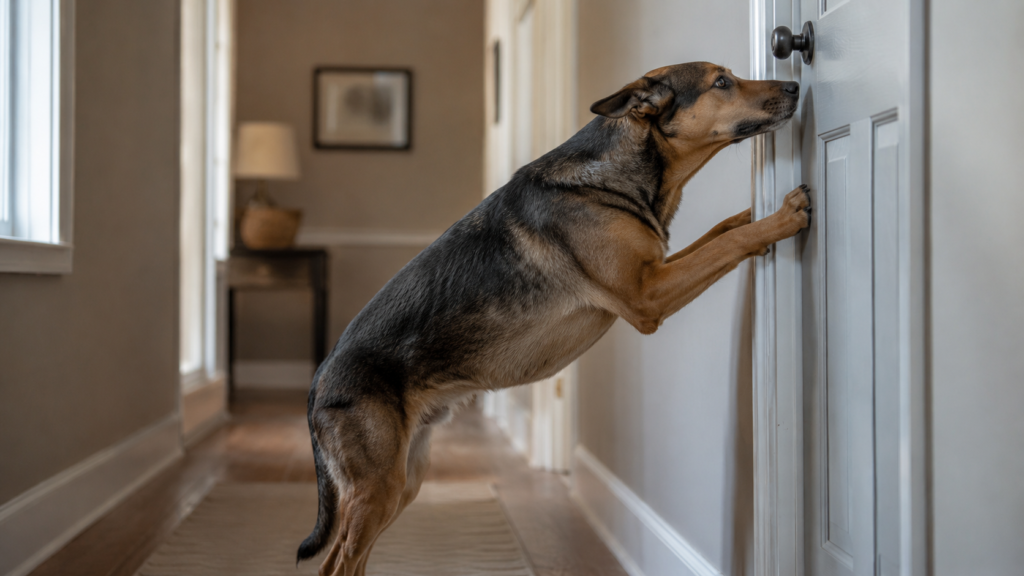
- Scratching or chewing at doors and windows in escape attempts
- Excessive drooling or panting in a cool environment
- Eliminating indoors despite being reliably house-trained
- Refusing food, treats, or enrichment toys while alone — even high-value items the dog loves
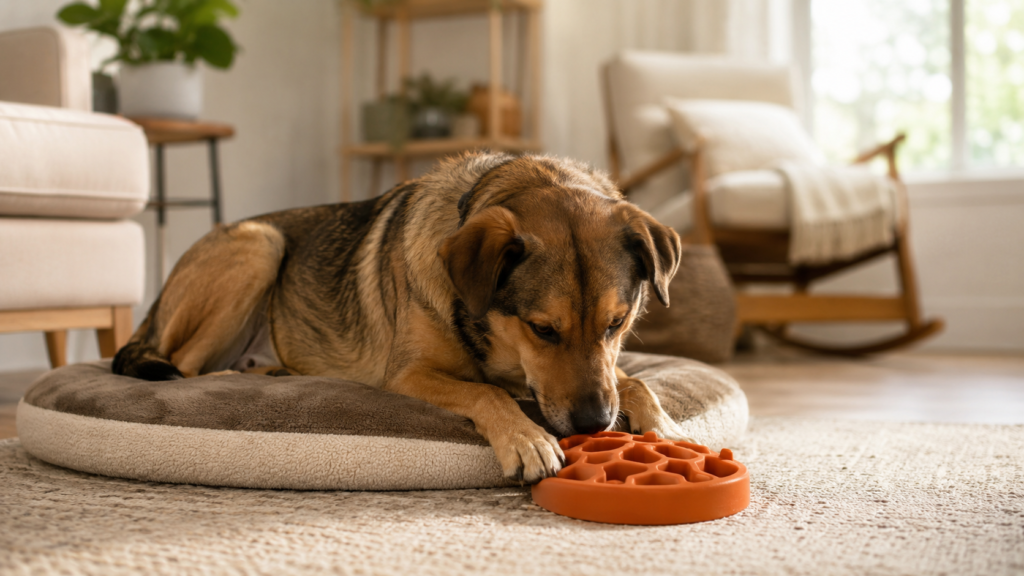
That last point — refusing food and enrichment while alone — is one of the most reliable indicators of true separation anxiety. A dog in genuine panic is physiologically incapable of settling enough to eat or engage with a toy. This is very different from a bored dog who ignores a Kong for ten minutes before eventually working on it.
Boredom: What It Actually Looks Like
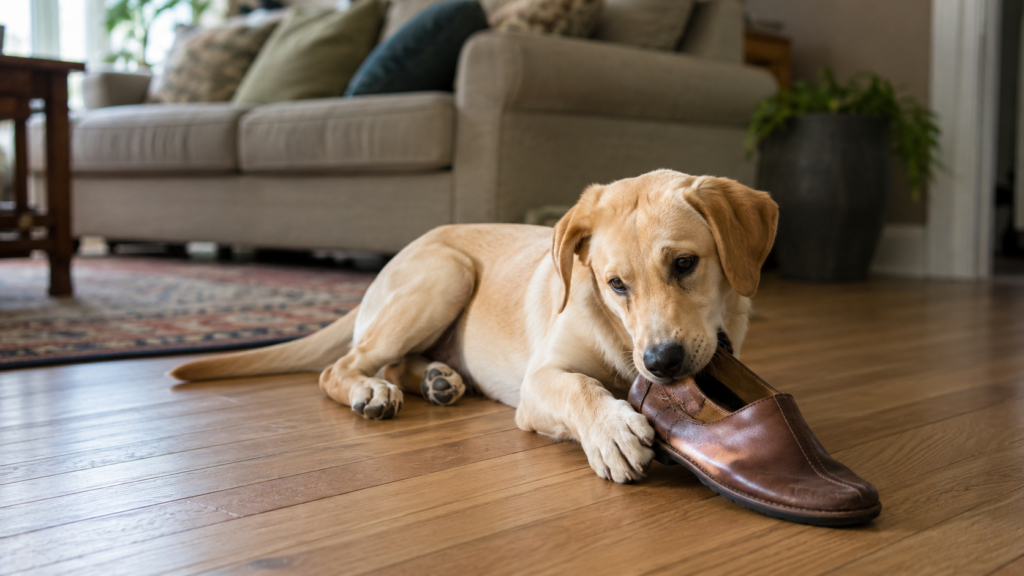
Boredom looks destructive on the surface but has a completely different character underneath. A bored dog is looking for something to do — and they’ll find it, whether that means chewing furniture, emptying the trash, stealing socks, digging in the yard, or finding creative ways to entertain themselves.
Unlike a dog with separation anxiety, a bored dog can usually settle after they’ve entertained themselves for a while. Many will happily engage with a food puzzle, take a nap, or simply wait for you to come home once they’ve burned through their initial energy. The behavior is opportunistic rather than driven by panic. They’re not distressed — they’re bored.
The Diagnostic Table: Key Differences Side by Side
| Factor | True Separation Anxiety | Boredom / Under-Stimulation |
|---|---|---|
| When does it start? | Within minutes of owner leaving | Usually after a period of waiting |
| Emotional state | Genuine panic and distress | Seeking stimulation, opportunistic |
| Will they eat or use food toys? | Usually no — even high-value items are refused | Usually yes, at least eventually |
| Do they settle during alone time? | Rarely — often distressed entire absence | Yes — often nap or self-entertain |
| Vocalization pattern | Continuous, doesn’t stop | Intermittent, quiets between outbursts |
| Destruction pattern | Near exits — doors, windows, escape routes | Random targets — whatever is interesting |
| House training accidents | Common despite being reliably trained | Uncommon in a reliably trained adult dog |
The destruction location is particularly telling: a dog with separation anxiety typically targets exits — doors, window frames, the doorjamb — because they’re trying to escape and reach their person. A bored dog tends to target whatever is interesting or accessible — a shoe left on the floor, the trash can, a couch cushion within reach.
Age Is a Major Factor
Many destructive dogs are adolescents — and many owners immediately jump to separation anxiety when the real explanation is developmental. Young dogs have more energy, shorter attention spans, a greater drive to explore, and a stronger need to chew. That’s not separation anxiety — it’s a dog acting their age, in a household that may not yet have established enough structure, training, and appropriate outlets for that energy.
Before assuming anxiety, it’s worth asking: Has this dog had sufficient physical and mental exercise? Do they have a predictable daily routine? Do they have appropriate chew outlets? Have they ever actually been trained to settle calmly when alone? For many adolescent dogs, the answer to one or more of those questions is no — and addressing that directly often resolves the behavior without any anxiety intervention at all.
One Thing That Makes Both Worse: Your Reaction at Homecoming
This finding from the research surprises many owners, and it’s worth understanding clearly. The Generation Pup study found that puppies whose owners fussed over bad behavior on returning home — scolding the destruction or making a big emotional production of the homecoming — were 6 times more likely to develop separation-related issues than puppies whose owners returned calmly and neutrally.
Quiet, matter-of-fact returns were the single biggest protective factor the researchers identified. Whether your dog has anxiety or boredom, coming home calmly and not reinforcing the reunion with high emotional intensity reduces the contrast between “owner present” and “owner absent” — which is one of the core things that fuels both problems.
What Helps for Boredom
If your honest assessment is that your dog is bored and under-stimulated rather than genuinely anxious, the solutions are straightforward — though they still require consistency:
- Increase structured mental stimulation — training sessions, food puzzles, scent games — not just physical exercise
- Establish a predictable daily routine so the dog knows when activity happens and when rest is expected
- Provide appropriate chew outlets before you leave
- Reduce unsupervised freedom — crating or confining a bored, destructive dog prevents the rehearsal of unwanted behavior while you work on the underlying issue
- Ensure the dog has been adequately exercised and mentally engaged before alone time begins
Structure is often the missing ingredient. Dogs that have clear, predictable routines — exercise time, training time, rest time, meal time — handle alone time considerably better than dogs whose days are unpredictable. Predictability reduces uncertainty, and uncertainty is often what fuels stress of all kinds.
What Helps for True Separation Anxiety
True separation anxiety requires a fundamentally different approach — and it rarely resolves without a structured plan. Simply tiring the dog out, providing more toys, or “waiting for them to get used to it” doesn’t address the emotional panic at the root of the problem.
Effective approaches typically involve teaching the dog to be alone in very small increments — starting with absences measured in seconds rather than minutes — and building up gradually as the dog demonstrates the ability to remain calm at each level. This process is called systematic desensitization, and it works best when paired with medications in moderate to severe cases. Separation anxiety is one of the leading behavioral reasons dogs are surrendered to shelters, which underscores why addressing it early with professional guidance matters — both for the dog’s welfare and for the owner’s ability to maintain the relationship.
Professional help is strongly recommended for true separation anxiety, particularly when the dog is injuring themselves in escape attempts, when the duration or severity of distress is significant, or when initial management approaches haven’t produced improvement.
Frequently Asked Questions
How do I know if my dog has separation anxiety or is just bored?
The most reliable indicator is whether your dog can settle, eat, or engage with enrichment while alone. A truly anxious dog typically can’t — they’re in a panic state from the moment you leave. A bored dog usually can settle, at least eventually. Setting up a basic home camera to watch what actually happens in the first 15 to 30 minutes after you leave is one of the most useful diagnostic steps you can take. What you see often tells you more than any symptom checklist.
Can exercise cure separation anxiety?
No — though it can reduce baseline arousal and make the dog easier to manage. Exercise addresses excess energy, which is a boredom factor, not an anxiety factor. A dog with true separation anxiety may be calmer after a walk, but they can still panic when left alone. Exercise is part of the management plan for both conditions, but it’s not a cure for either.
My dog only destroys things when I’m gone. Does that mean separation anxiety?
Not necessarily — most destructive alone-time behavior is boredom rather than anxiety. The key is the character of the destruction (near exits vs. random targets), whether the dog can settle and eat while alone, and whether the distress begins immediately or after a period of waiting. If your dog is fine on a camera for 20 minutes and then chews a shoe, that’s boredom. If they’re panting and pacing at the door before you’ve even left the street, that’s a different conversation.
Should I crate a dog with separation anxiety?
It depends entirely on the individual dog. Some dogs feel genuinely secure in a crate and show less distress when confined. Others become even more panicked in a crate and may injure themselves trying to escape. Never assume the crate will help — observe your dog’s response carefully before leaving them crated for extended periods, and if they show escalating distress in the crate, seek professional guidance before continuing that approach.
My dog does fine when a dog sitter is there but panics when completely alone. What does that tell me?
It suggests the anxiety is specifically about being alone, not about the departure ritual or the environment itself. Many dogs with separation anxiety are fine with any human present — even a stranger — but cannot tolerate being alone regardless of where they are. This is useful information for management (dog sitters, daycare) while working on the underlying issue, and it narrows the focus of the training plan.
How is the pandemic relevant to separation anxiety today?
Very relevant. Dogs acquired during 2020 and 2021 often spent their entire early socialization period with owners at home around the clock — never learning that being alone was normal. Reports of separation anxiety-related behaviors increased significantly as owners returned to offices and normal routines. Separation anxiety became one of the leading behavioral reasons dogs were surrendered to shelters in the post-pandemic period. If your dog came from the pandemic era, the baseline risk for separation-related issues is meaningfully higher than for dogs raised with more typical absence patterns.
Can dogs grow out of separation anxiety?
Rarely on their own. Some adolescent dogs show separation-related behaviors that improve as they mature and settle — but true separation anxiety typically requires active intervention to improve. Without a structured training approach, the anxiety often remains stable or worsens over time as the pattern becomes more established. Early intervention consistently produces better outcomes than waiting.
What’s the first step if I think my dog has true separation anxiety?
Start by confirming what’s actually happening when you’re gone — set up a camera and watch the first 30 minutes after departure. If what you see looks like genuine panic (continuous distress, escape attempts, inability to settle), reach out to a professional trainer or veterinary behavior specialist sooner rather than later. True separation anxiety is one of the more complex behavioral issues to address, and the approaches that help are meaningfully different from general obedience or behavior modification training. Our free consultation is a good starting point to talk through what you’re seeing and whether it’s something we can help with.
Not Sure What’s Driving Your Dog’s Alone-Time Behavior?
Whether your dog is bored and under-stimulated or showing signs of genuine anxiety, our adult dog training program is built around understanding the root cause and building a plan that actually addresses it. Schedule a free consultation and let’s talk through what you’re seeing.
Free Consultation