
Quick Summary
- Exercise is essential for your dog’s health — but it’s not a substitute for training. A dog can run five miles and still pull on the leash, jump on guests, and ignore recall.
- Mental stimulation often tires dogs more effectively than physical exercise alone — most high-energy dogs who get plenty of exercise but inadequate mental engagement still exhibit problem behaviors.
- Dogs can be conditioned to need more and more exercise without ever learning to settle — the goal is a calm dog, not just a tired one.
- Exercise needs vary significantly by breed, age, and individual — a Border Collie and a Bulldog are not working from the same baseline.
- The best routine combines physical exercise, mental stimulation, structured training, and taught calmness — each serves a different purpose.
One of the most common pieces of advice dog owners hear is: “Your dog just needs more exercise.” If they’re barking — exercise them more. If they’re chewing furniture — exercise them more. If they’re jumping on guests — exercise them more.
Exercise is genuinely important for your dog’s physical and mental health. But it isn’t the solution to every behavior problem. One of the biggest misconceptions in dog training is that a tired dog is automatically a well-behaved dog. The reality is more nuanced — and understanding the difference changes how you approach both exercise and training.
What Exercise Actually Does (And Doesn’t Do)
Regular physical activity helps maintain a healthy weight, supports cardiovascular and joint health, reduces stress, and provides an outlet for energy. A dog that never gets exercise is far more likely to develop unwanted behaviors — that much is true. Dogs usually require exercise outside the home not only for physical health but also for mental stimulation, and their exercise requirements far exceed those of other common companion animals.
But exercise alone doesn’t teach your dog how to behave. A dog can run five miles and still pull on the leash, jump on guests, bark at every noise, ignore recall, counter surf, and chase squirrels. Those are training issues, not exercise issues. Physical exercise burns energy. Training changes behavior. They’re both important, but they accomplish fundamentally different things.
You Can’t Outrun the Need for Training
Many owners respond to unwanted behavior by simply increasing exercise — and sometimes that helps, particularly when the behavior is rooted in boredom or excess energy. But often it doesn’t, for a straightforward reason: exercise doesn’t teach your dog what you want them to do instead.
Consider the analogy: if someone yells every time they get frustrated, would making them run a marathon teach them patience? Probably not. Running uses energy, but it doesn’t build the self-regulation skills that patience requires. The same logic applies to dogs. Increasing exercise addresses the fuel level. Training changes the behavior pattern itself.
Most high-energy dogs who receive ample physical exercise but inadequate mental stimulation still exhibit problem behaviors. Dogs engaged in regular mental activities demonstrate improved impulse control, enhanced focus during training sessions, and reduced anxiety. That’s a meaningful distinction — the behaviors most owners want to change (jumping, pulling, ignoring commands) are impulse control issues, not energy issues. Exercise doesn’t specifically target impulse control. Training does.
Mental Exercise Can Be Even More Tiring
Have you ever noticed how mentally exhausted you feel after a day of concentrated learning compared to a day of physical activity? Dogs experience the same dynamic. Mental exercises often tire dogs more effectively than physical activities alone — brain games force dogs to concentrate and use problem-solving skills in ways that walks simply don’t replicate.
A focused 15-minute training session often tires a dog more thoroughly than a 45-minute walk, because learning requires sustained concentration, self-control, and active problem-solving. Mental stimulation might include obedience training, nose work and scent games, food puzzles, learning new skills, shaping exercises, and confidence-building exploration in new environments. These activities challenge the brain while simultaneously strengthening the relationship between dog and owner — something that a solo run in the backyard doesn’t provide.
Teaching Calmness: The Goal Most Owners Miss
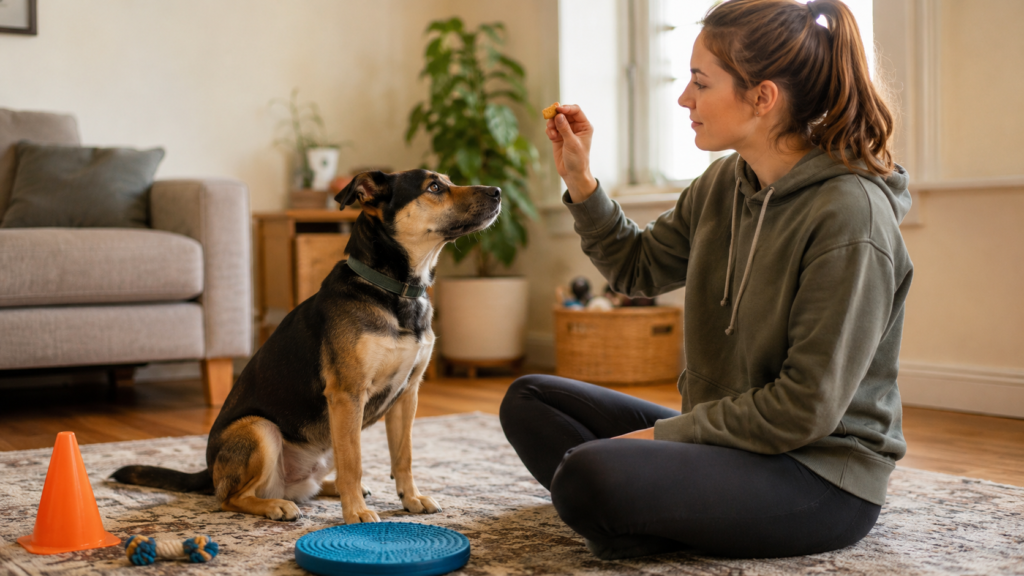
One of the biggest goals in our training programs isn’t creating a tired dog. It’s creating a calm dog. Those aren’t the same thing — and confusing them is one of the most common reasons owners feel like they’re running on a treadmill with their dog’s behavior.
Some dogs become incredible athletes because they’re constantly exercised. The more they’re exercised, the fitter they become — and the more exercise they need to reach the same level of tiredness. Meanwhile, they never actually learn how to relax. The dog’s exercise tolerance has been built up, but their self-regulation hasn’t been trained at all.
Instead of asking “how do I wear my dog out?” the more productive question is: “have I taught my dog how to settle?” Relaxation is a behavior that can be taught just like sit or down — and it’s one of the most valuable skills a dog can learn. A dog that knows how to settle calmly on a mat, disengage from stimulation, and rest independently is a fundamentally different dog to live with than one who needs to be exhausted before they’ll stop demanding attention.
How Much Exercise Does Your Dog Actually Need?
There isn’t one universal number that applies to every dog. Breed, age, health status, and individual temperament all play significant roles. Herding breeds like Border Collies and Australian Shepherds need a minimum of 60 minutes of physical activity plus additional mental enrichment, while lower-energy breeds like English Bulldogs may need as little as 20 to 30 minutes of moderate activity daily. Comparing your dog to a neighbor’s different-breed dog is rarely useful.
Age matters significantly as well:
- Puppies have bursts of intense energy followed by long sleep periods — they need more frequent shorter activity rather than long sustained exercise, and their joints shouldn’t be overloaded before skeletal maturity
- Adolescents (roughly 6–18 months) often have the highest energy demands of their lives and benefit most from the combination of physical exercise, mental stimulation, and structured training
- Adult dogs generally have settled energy levels that are more predictable and easier to meet with a consistent routine
- Senior dogs need less intense activity but still benefit significantly from regular gentle exercise to maintain strength, mobility, and cognitive health
Pay attention to your individual dog rather than a chart. A dog that is consistently restless, pacing, seeking attention, or getting into things is telling you they need more — more physical activity, more mental engagement, more training, or some combination. A dog that settles naturally, rests well, and is calm and focused is telling you the current balance is working.
Quality Over Quantity
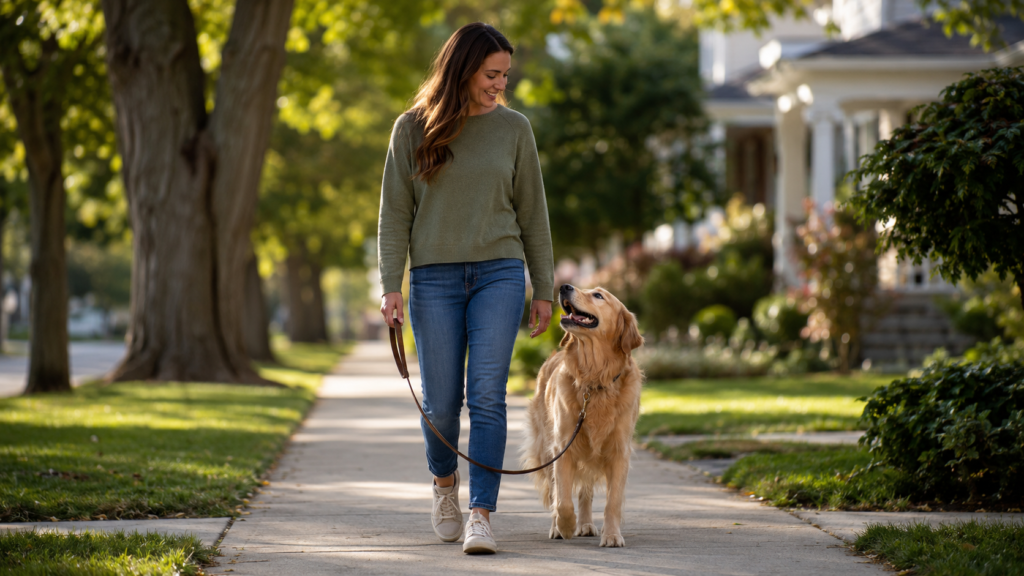
An hour of pulling on the leash isn’t nearly as valuable as 30 minutes of engaged, purposeful activity. The difference lies in what the dog is doing mentally during the exercise. A walk where the dog is dragging ahead, scanning the environment for things to react to, and completely ignoring their owner builds excitement and arousal — not the settled engagement that good exercise should produce.
A structured walk where the dog checks in with the owner, walks on a loose leash, responds to occasional cues, and moves through the environment calmly is significantly more beneficial — physically and behaviorally. The same principle applies to fetch: fetch with impulse control built in (sit before release, wait for the throw) is more valuable than mindless ball chasing that ramps arousal without providing any self-regulation practice.
Reading the Signs: Exercise vs. Training vs. Enrichment
One of the most practical skills an owner can develop is distinguishing between behaviors that signal a need for more activity, behaviors that signal a need for more training, and behaviors that signal both. The distinction changes where you put your effort.
| Behavior | Likely Root Cause | What Helps |
|---|---|---|
| Chewing inappropriate items, pacing, restlessness | Boredom, under-stimulation | More physical exercise and mental enrichment |
| Pulling on leash, jumping on guests, ignoring recall | Training gaps, lack of impulse control | Structured training — more exercise won’t fix these |
| Hyper after lots of exercise, unable to settle | Calmness has never been taught | Teach a settle or place behavior; reduce exercise intensity |
| Barking at noises, people, other dogs | Reactivity — fear, frustration, or excitement | Training and confidence-building; exercise alone won’t resolve it |
| Counter surfing, digging, creative self-entertainment | Boredom combined with no appropriate outlet | Both enrichment and management/training to redirect |
The Best Routine Combines Both
The happiest, most reliable dogs typically have a balanced routine that includes physical exercise, mental stimulation, structured training, time to explore, and genuine rest. Each component serves a different function — and none of them is fully replaceable by the others.
Exercise keeps the body healthy and burns physical energy. Training teaches good choices and builds impulse control. Mental enrichment keeps the mind engaged and satisfied. Rest allows the dog to consolidate learning and recover. Combining physical and mental exercise leads to better behavior, improved focus, and overall emotional balance — dogs lacking either physical activity or mental stimulation often resort to self-directed activities that manifest as problematic behaviors.
The goal isn’t a dog that’s exhausted enough to be manageable. The goal is a dog that is physically healthy, mentally satisfied, well-trained, and genuinely calm. Those are four different things, and a complete routine addresses all of them.

Frequently Asked Questions
Can you exercise a dog too much?
Yes, in two different ways. Physically, over-exercising puppies before skeletal maturity can cause joint damage — the general guideline for leash walking is 5 minutes per month of age, twice daily. Behaviorally, constantly trying to exhaust your dog can build exercise tolerance without ever building calmness. Dogs conditioned to high exercise levels often need more and more activity to reach the same level of tired, without ever learning to settle on their own. Balance is the goal, not maximum exhaustion.
Is a daily walk enough exercise for my dog?
For some dogs, yes — particularly lower-energy breeds and senior dogs. For others, particularly herding breeds, sporting breeds, and adolescents, a single daily walk is unlikely to be sufficient on its own. The quality of the walk matters as much as the duration: a structured 30-minute walk where the dog is engaged and focused often provides more benefit than an hour of pulling on the leash. Supplement walks with training sessions and mental enrichment for the most complete routine.
Is fetch enough exercise for my dog?
Fetch is excellent physical exercise, but it’s worth knowing what else it does behaviorally. Repetitive high-arousal fetch can actually increase a dog’s overall excitement level and make it harder for them to settle — it builds cardiovascular fitness but not self-regulation. Adding impulse control elements (sit before the throw, waiting for a release cue) converts fetch from pure arousal into a training opportunity as well. Don’t rely on it as your dog’s only activity.
Why is my dog still hyper after lots of exercise?
This is one of the most common things owners experience, and it usually means one of two things: the dog has built a high exercise tolerance and needs diminishing returns of more and more activity, or the dog has simply never been taught how to settle — and no amount of exercise changes that, because calmness is a trained behavior, not the automatic result of being tired. Adding structured training and a specific settle or place cue often resolves this much faster than adding more exercise.
My dog is a high-energy breed. Does that mean they need hours of exercise every day?
High-energy breeds do have greater exercise needs than low-energy breeds, but “hours of exercise” isn’t necessarily the right framing. Herding and working breeds benefit most from a combination of physical activity and mental stimulation — an hour of exercise plus meaningful mental engagement often produces a calmer, more satisfied dog than two hours of purely physical activity. The mental component is frequently what’s missing, not more miles.
My puppy seems to have endless energy. How much exercise is appropriate?
Puppies have bursts of intense energy followed by significant sleep — often 16 to 18 hours a day for very young puppies. The energy bursts can feel endless, but forcing long sustained exercise isn’t the right response. Short structured sessions, training, mental enrichment, and enforced nap time (crate) are more appropriate than long walks that stress developing joints. The general guideline is 5 minutes of leash walking per month of age, twice daily, as a starting point for formal exercise — supplemented by play and training.
Does mental stimulation really tire dogs as much as physical exercise?
For many dogs, yes — and for some, more so. Mental exercises often tire dogs more effectively than physical activities because they require concentration and active problem-solving. A dog that has completed a meaningful training session is often noticeably calmer and more settled than one that has just been for a walk. This is particularly true for dogs that are mentally sharp and underutilized — breeds developed for thinking-intensive jobs (herding, detection, protection) are especially responsive to mental engagement.
My dog has behavior problems. Should I focus on exercise or training first?
It depends on which behaviors you’re seeing. Boredom-rooted behaviors (chewing, pacing, restlessness) respond well to increased physical and mental activity. Obedience-related behaviors (pulling, jumping, ignoring commands) are training gaps that more exercise won’t fix. In most cases, increasing both exercise and training simultaneously produces the best results — and adding structure to the exercise itself (loose leash walking, place command, impulse control games) means the exercise time does double duty. Our free consultation can help you figure out exactly what your dog needs.
Ready to Go Beyond Just Tiring Your Dog Out?
Our training program builds the obedience, impulse control, and genuine calmness that exercise alone can’t create — in a real home environment with only 2 dogs per trainer at a time. Schedule a free consultation and let’s talk about what your dog actually needs.
Free Consultation