
Quick Summary
- Leash pulling is rarely about stubbornness — it’s most often a focus problem, not a leash problem.
- Pulling is self-reinforcing: every time a dog pulls and gets where they want to go, the habit gets stronger.
- No piece of equipment alone teaches a dog what you want — training creates lasting change, equipment just manages the process.
- Start training in a low-distraction environment long before you expect results on a busy walk.
- Engagement — teaching your dog that paying attention to you is genuinely valuable — is the foundation everything else is built on.
Few things drain the enjoyment out of dog ownership faster than being dragged down the street every time you try to take your dog for a walk. Your shoulders ache. Your arms hurt. Your dog is completely checked out. And what should be a relaxing part of your day starts feeling like a chore you’d rather skip.
If you’ve been asking, “Why does my dog pull on the leash?” — you’re in good company. It’s one of the most common problems dog owners face, and it’s also one that tends to get worse rather than better when left unaddressed.
After training thousands of dogs over two decades, I’ve found that leash pulling is rarely about stubbornness. In most cases it comes down to excitement, habit, lack of focus, and a simple misunderstanding of what we actually want the dog to do.
The good news is that once you understand what’s driving the pulling, fixing it becomes much more straightforward.
Why Leash Pulling Is Worth Taking Seriously
Beyond the frustration, leash pulling carries real physical risk. A Johns Hopkins study published in Medicine & Science in Sports & Exercise found that an estimated 422,659 adults sought treatment in U.S. emergency rooms for injuries from leash-dependent dog walking between 2001 and 2020 — with annual injury numbers increasing more than fourfold over that period, from around 7,200 in 2001 to 32,000 in 2020. The most common injuries were broken fingers, shoulder sprains, and traumatic brain injuries.
A 2024 review in the Journal of the American Veterinary Medical Association confirmed that dog-pulling behavior is the leading cause of these injuries — not tripping, not tangles, but the pull itself. This is a solvable training problem that has real consequences when it’s left unaddressed.
Why Dogs Pull: The Simple Explanation
Start with the most honest question: why wouldn’t they pull?
From your dog’s perspective, they want to smell that tree, greet that dog, chase that squirrel, and explore everything they can see. Every time they pull and successfully move closer to what they want, pulling is rewarded. The leash goes tight, they keep moving forward, and eventually they reach the thing. From their point of view, pulling worked.
Leash pulling is a self-reinforcing behavior. The more a dog practices it, the better they get at it, and the more ingrained the habit becomes. This is why leash pulling often gets worse over time without intervention — not because the dog is being defiant, but because the habit has been reinforced thousands of times.
Leash Pulling Is Usually a Focus Problem
Many owners think of leash pulling as a leash problem and go looking for a leash solution. In most cases, it’s actually a focus problem.
If your dog is locked onto other dogs, squirrels, smells, and strangers, they have very little attention left for you. And a dog that isn’t paying attention to you cannot walk politely with you. The equipment on the leash doesn’t change that equation — only building genuine engagement does.
One of the foundations of our training system is this: before asking your dog to walk politely beside you, they need to learn that paying attention to you is genuinely valuable. The more value you hold in your dog’s eyes, the easier every aspect of training becomes — including loose leash walking.
The Biggest Mistake Owners Make
The most common mistake we see is trying to fix leash pulling during the walk itself, when the dog is already excited, distracted, overstimulated, and focused on everything except the owner.
At that point, you’re already behind. Trying to train a highly aroused dog in a high-distraction environment is like trying to teach algebra in the middle of an amusement park. Could it happen? Theoretically. Would it be far easier somewhere quiet? Without question.
Loose leash walking starts long before you step outside. The relationship, the focus, and the impulse control all need to be built first — then they transfer to the walk.
Why Equipment Alone Doesn’t Solve It
Every year new tools appear promising to eliminate leash pulling instantly. Special harnesses, head halters, no-pull devices, training gadgets of every description. Some of these tools can be useful as part of a broader plan. None of them teach your dog what you actually want.
Interestingly, a 2025 study in the Journal of Veterinary Behavior found that dogs actually pulled with significantly greater force when wearing a harness compared to a flat collar — with peak pulling force nearly 20% higher in the harness condition. The point isn’t that harnesses are bad. It’s that equipment manages the situation. Training changes the behavior. The goal should always be teaching the dog, not permanently relying on the tool.
What Actually Works: Building the Foundation
Start With Engagement
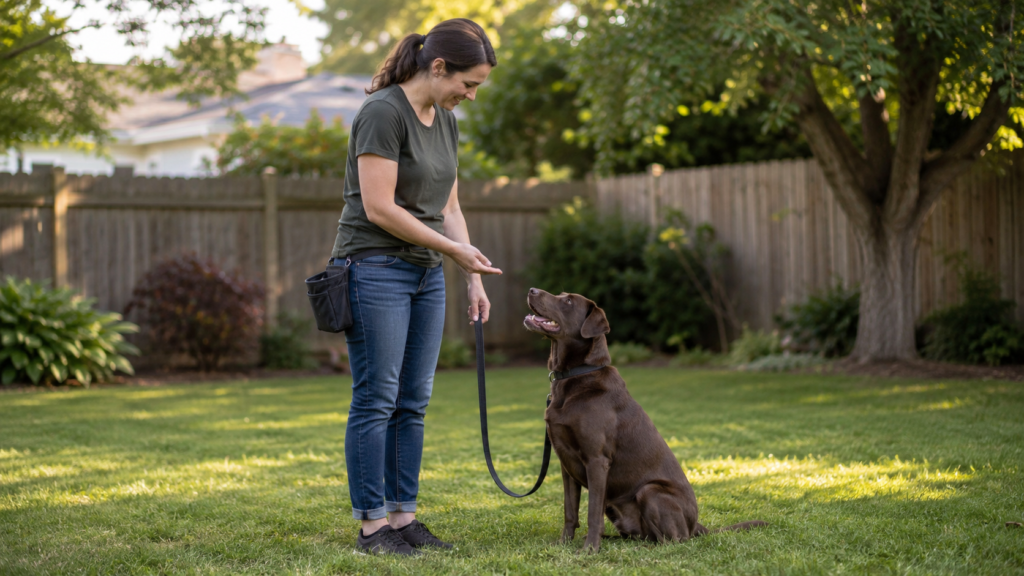
The foundation of loose leash walking isn’t a technique — it’s a relationship. Your dog needs to learn that staying connected to you is genuinely rewarding. This starts in low-distraction environments, long before you ever attempt a structured walk on a busy street.
Begin by rewarding your dog simply for looking at you, following your movements, and choosing you over distractions. Many owners spend all their time correcting mistakes. We prefer spending far more time rewarding success. Dogs repeat behaviors that work — so make paying attention to you work better than anything else in the environment.
Use Food as a Training Tool
Food is not bribery. Food is communication. Many owners underestimate how powerful it is when used correctly. Research consistently supports reward-based training as the most effective and humane approach, and organizations including the American Veterinary Society of Animal Behavior (AVSAB), the Association of Professional Dog Trainers (APDT), and the Humane Society all recommend it as the standard for obedience training and rehabilitation.
The goal isn’t simply to get your dog to follow food. The goal is to create a dog that genuinely enjoys working with you — a dog that finds engagement with you more interesting than whatever else is happening. Once that relationship is established, loose leash walking becomes far easier to build.
Start in a Low-Distraction Environment
One of the most common reasons training fails is moving too fast. If your dog cannot focus in your living room, they will not suddenly focus at a busy park. Start somewhere easy — your backyard, your driveway, a quiet side street. Build success before increasing the difficulty.
As your dog improves and demonstrates reliable focus, gradually introduce more distractions. This process helps your dog learn how to succeed rather than constantly struggle. And every successful repetition builds the habit you’re trying to create.
Build Impulse Control
If there’s one concept that ties together nearly every leash walking problem — and most training problems in general — it’s impulse control. Most dogs know what their owner wants. They simply can’t do it when excitement takes over.
Teaching simple exercises like sit, down, place, stay, and wait builds the mental muscle your dog needs to pause before reacting. A dog practicing these skills daily develops the self-regulation that shows up on walks as the ability to hold focus even when a squirrel runs by or another dog approaches. The problem usually isn’t that your dog doesn’t know what you want. It’s that they can’t override the impulse in the moment. Impulse control training closes that gap.
What the Real Goal of Loose Leash Walking Actually Is
Many owners picture perfect obedience: the dog glued to their side, never looking away, never sniffing, never showing any interest in the world around them. That standard isn’t realistic for most families — and it isn’t the goal.
Walking should still be enjoyable for your dog. The goal is balance. Your dog should be able to walk politely, pay attention to you when asked, explore appropriately, respond when called back, and enjoy the experience. Loose leash walking is really about communication — a conversation between you and your dog about what’s appropriate when, rather than a military march down the street.
Common Mistakes That Make Pulling Worse
| Mistake | Why It Backfires | What to Do Instead |
|---|---|---|
| Trying to train during the walk when the dog is already aroused | A highly distracted dog has almost no bandwidth for learning new rules | Build focus and engagement at home first, then gradually transfer to outdoor environments |
| Relying entirely on equipment (harnesses, head halters, no-pull devices) | Equipment manages pulling; it doesn’t teach the dog what you want | Use equipment as a management tool while training the actual behavior |
| Allowing pulling sometimes and correcting it other times | Inconsistency teaches the dog to keep trying — intermittent reinforcement is very strong | Decide on your standard and hold it every single time |
| Moving to busy environments too quickly | Setting the dog up to fail before the foundation is in place | Start easy, build success, then gradually increase difficulty |
| Ignoring the relationship and focusing only on technique | A dog that doesn’t value the owner’s attention won’t work to maintain it | Build engagement first — the technique becomes far easier when the relationship is solid |
What to Do When Your Dog Sees Another Dog
Many of the worst leash-pulling moments happen around other dogs. Owners typically wait until their dog is already barking, lunging, and completely over threshold — then try to intervene. By that point, it’s too late for the current repetition.
Instead, begin working the moment your dog notices the distraction — before the arousal peaks. Get their attention, reward focus, and create distance if needed. Distance is one of the most powerful training tools available. You don’t need to put your dog in situations they can’t yet handle. Success builds the habit. Exposure at a level the dog can manage while still focusing on you is far more productive than forcing them through situations where they fall apart.
Exercise Helps — But It Isn’t the Whole Answer
Many owners assume a pulling dog simply needs more exercise. Sometimes that’s true. Often it isn’t. A dog can be physically tired and still completely lack self-control on the leash. Physical and mental stimulation are different things, and leash pulling is primarily a self-control and focus issue — not an energy surplus issue.
Mental exercise — training sessions, food puzzles, scent games, problem-solving activities — often tires dogs faster than endless physical activity, and it builds exactly the kind of cognitive regulation that translates to better leash behavior. If your dog is getting long runs every day but still pulling like a freight train, adding more physical exercise probably isn’t the missing piece. Building focus and impulse control is.
Puppies vs. Adult Dogs: Different Causes, Same Foundation
Puppies and adult dogs pull for different underlying reasons, though the training approach shares the same foundation.
Most puppies pull simply out of curiosity. Everything in the world is new — every smell, every leaf, every person passing by deserves immediate investigation. That curiosity is completely normal and worth preserving. The goal isn’t to eliminate it. The goal is to teach your puppy how to explore the world without dragging you with them. Starting early matters here because good habits are far easier to build than bad ones are to break.
Adult dogs, on the other hand, often pull because the behavior has been unintentionally reinforced for months or years. A dog that has practiced pulling to reach everything interesting has done it thousands of times. At that point it’s a deeply ingrained habit — not stubbornness, not defiance, just a pattern that has been rewarded over and over again. Habits can be changed, but they require consistency and realistic expectations about the timeline. You’re not just teaching a new skill. You’re replacing an established one.
How Long Does It Take to Stop Leash Pulling?
This varies considerably depending on age, training history, temperament, consistency, and how much the pulling has been reinforced over time. Some dogs improve noticeably within a few weeks of consistent work. Others with years of ingrained habits may take several months.
The most important thing to remember is that you’re changing a habit, not just correcting a behavior. Industry data shows that obedience training — including loose leash walking — held the largest revenue share of the dog training market in 2024, reflecting how many owners are actively seeking real, lasting solutions rather than quick fixes. The owners who get there fastest are the ones who commit to consistent daily practice rather than occasional correction. Every successful repetition moves you in the right direction.
Frequently Asked Questions
Why does my dog pull harder when they see another dog?
High arousal overrides focus. When a dog gets excited at the sight of another dog, their brain is flooded with stimulation and self-control goes out the window. This is exactly why impulse control training and working below threshold matter so much — the goal is to build the habit of focusing on you before excitement peaks, not after.
Should I stop letting my dog sniff on walks?
No — sniffing is one of the most mentally enriching things a dog can do on a walk. The goal isn’t to eliminate it. The goal is to teach your dog when they may explore and sniff, and when you need their focus. Sniffing on cue, released from a heel, is a perfectly reasonable middle ground that satisfies your dog’s needs without giving up all structure.
Is a harness better than a collar for a pulling dog?
The honest answer is: it depends on the dog and the training plan. A well-fitted harness works well for many puppies and dogs with sensitive tracheas. However, research has shown that dogs can actually pull harder in a harness than a collar. The tool matters less than the training behind it — neither a harness nor a collar teaches a dog to walk politely. That comes from the relationship and the work.
Can an older dog learn to stop pulling?
Absolutely. Older dogs may have stronger, longer-established habits, but they are fully capable of learning new behaviors. The process may take more time and consistent management than it would with a puppy, but the same principles apply. We’ve seen dogs with years of pulling habits become reliable loose-leash walkers with focused, consistent training.
Why is my dog perfect on leash at home but pulls the moment we go outside?
Because outside is a completely different environment with a completely different distraction level. A dog that walks beautifully in the backyard hasn’t learned to walk on a leash — they’ve learned to walk on a leash in the backyard. Loose leash walking needs to be trained progressively, starting in low-distraction environments and gradually working up to more challenging ones as reliability builds at each level.
My dog only pulls toward other dogs. Is that a different problem?
It’s the same root issue — high arousal overriding self-control — but with a specific trigger. Whether a dog pulls toward everything or only toward other dogs, the solution is the same: build engagement and impulse control, work below the threshold where the dog loses focus, and reward heavily for choosing you when the trigger is present. Dogs that are particularly reactive toward other dogs may also benefit from more structured work on that specific challenge. Our adult training program addresses leash reactivity as a core component of the off-leash obedience work.
Is leash pulling a sign of dominance?
No. This is one of the most persistent myths in dog training. Leash pulling is not about your dog trying to be in charge. It’s about a self-reinforcing behavior — the dog pulls, gets closer to what they want, and the habit strengthens. Understanding the actual cause matters because it points you toward the right solution: building focus and engagement rather than trying to “win” a power struggle that isn’t actually happening.
We’ve tried training before and nothing has worked. What are we missing?
In most cases when training hasn’t produced results, one of three things is happening: the environment is too distracting for the stage of training the dog is at, the rules are inconsistent (pulling sometimes works and sometimes doesn’t), or the engagement piece hasn’t been built before asking for leash behavior. If you’ve tried and hit a wall, professional help can identify exactly where the gap is and give you a clear path forward. Our free consultation is a good place to start that conversation.
Tired of Being Dragged on Every Walk?
Leash pulling is one of the most common things we work on in our adult dog training program — and one of the most satisfying to fix. We work in a real home environment with only 2 dogs per trainer at a time, building the focus, impulse control, and obedience that make walks something you actually look forward to. Schedule a free consultation and let’s talk about what your dog needs.
Free Consultation